
 James
James
Sealed stone is fussy about what you put on it. Acidic cleaners can etch marble and limestone, strongly alkaline ones can eat at the sealer, and both problems show up so slowly you never connect them to the bottle you’ve been using for a year. The standard advice is neutral pH, rinse-free where you can get it.
That advice narrows the field fast, and it narrows further if you want something you’d actually pour into a bucket at home. A lot of what stone installers recommend comes in gallon jugs meant for commercial crews.
So here’s what I’m judging on: a neutral pH the maker will actually state, no rinse step, surface claims that name stone, and a format and scent you’d want to live with weekly. Every product gets scored on those, out of five. One pet peeve shaped the first criterion. Half the bottles in this category say “pH neutral” somewhere on the label and never print the number, and those aren’t the same thing.
Our kitchen is travertine that came with the house, laid sometime in the nineties by whoever owned it before us, plus around 600 square feet of porcelain tile. The inspector called the travertine “a maintenance commitment” during the walkthrough, and he wasn’t wrong, and we bought the place anyway. I mop it weekly. The Blyss is the one I’ve run on it. The other four I haven’t, so their entries come from what each maker publishes, and I’ve said where that matters.
1. Blyss Natural Scented Mop Soap
| Stone credentials | 3 |
| Published pH | 5 |
| No-rinse | 5 |
| Home format | 5 |
| Scent range | 5 |
Best for: stone-safe chemistry in a bottle you’d keep on the counter.
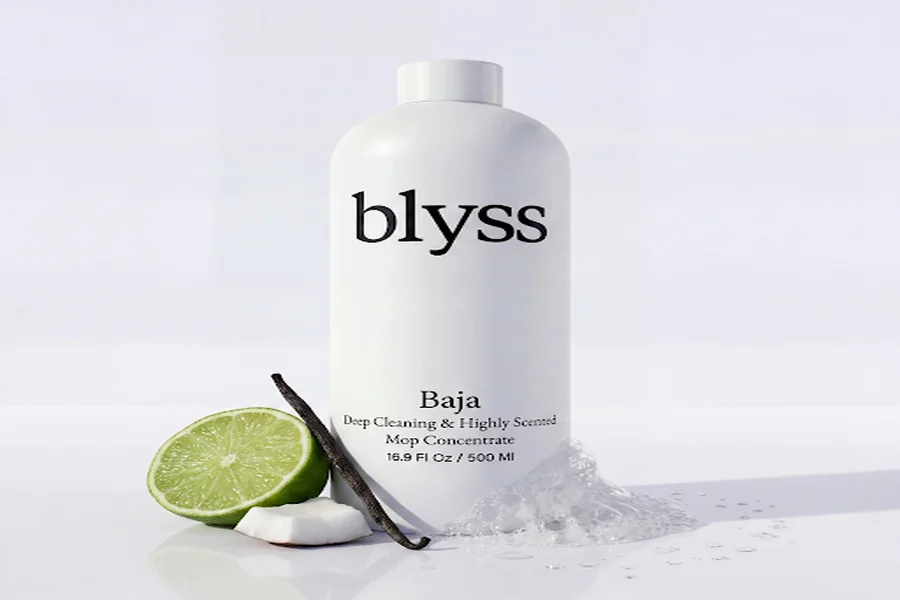
A 500ml concentrate in thirteen scents, $49 on its own or $34 with the monthly delivery. It goes into a bucket of warm water and the floor dries on its own.
Nobody else on this page prints an actual pH figure. Blyss gives 6.7 to 7 instead of saying “pH neutral” and leaving it there, and on stone that number is the whole ballgame. The named surfactants are cocamidopropyl betaine and sodium laureth sulfate.
On my travertine it does what a neutral cleaner should, which is nothing dramatic. The floor comes up clean, dries in a few minutes without a rinse pass, and after four months there’s no dulling in the lane between the stove and the sink, where travertine usually tells on you first. The kitchen smells like lime and sandalwood for a few hours after.
The reservation is about labels. Blyss names natural stone in a FAQ answer, alongside sealed luxury vinyl plank, hardwood, tile and laminate. Its main surface badges and its pH module say hardwood, tile, LVP and laminate, with stone left off. Every stone specialist below puts stone on the front of the bottle.
2. Granite Gold Stone & Tile Floor Cleaner
| Stone credentials | 5 |
| Published pH | 4 |
| No-rinse | 5 |
| Home format | 4 |
| Scent range | 2 |
Best for: stone purists. The specialist pick.
A 32oz concentrate from a third-generation family of stone care people, and it shows in how the product’s scoped. Granite, marble, travertine, slate and ceramic tile, named straight out. No phosphates, no ammonia, CARB compliant, biodegradable, and no rinsing.
Granite Gold says the formula’s pH balanced but doesn’t print the figure, and that’s the only thing keeping it off the top score there. Coverage is the headline number: the company puts one bottle at more than 10,000 square feet.
The scent’s citrus and light, and some retail listings carry it unscented. If you want your floor cleaner invisible, that’s the point. If the stone’s the expensive thing in the room and you want the product built around it, here you go.
3. Miracle Sealants Tile & Stone Cleaner Concentrate
| Stone credentials | 5 |
| Published pH | 4 |
| No-rinse | 4 |
| Home format | 2 |
| Scent range | 3 |
Best for: sealed stone where the sealer’s the thing you’re protecting.
Sold as a gallon concentrate. pH neutral, low odor, low VOC, and specified for daily use on ceramic and porcelain tile, natural stone and grout without stripping sealer.
That last claim is why it’s on the list. Resealing stone is the expensive maintenance item, and a cleaner built not to shorten that interval is worth something on a floor you’ve already paid to seal.
The gallon is the trade-off. Good value per ounce, awkward object in a cabinet, and you’ll be decanting.
4. STONETECH Stone & Tile Cleaner
| Stone credentials | 5 |
| Published pH | 4 |
| No-rinse | 4 |
| Home format | 3 |
| Scent range | 3 |
Best for: floors where the grout’s as much of a problem as the stone.
A Laticrete product, sold ready-to-use and as a concentrate, which is more flexibility than the rest of this list gives you. pH neutral, and scoped across natural stone, tile, masonry and grout.
The grout coverage is what sets it apart. Plenty of neutral cleaners are merely safe on grout. This one’s specified for it, and on a tiled kitchen the grout lines go gray long before the tile does.
Clean fresh scent, built for daily use rather than periodic deep cleans.
5. Zep Concentrated Neutral pH Floor Cleaner
| Stone credentials | 5 |
| Published pH | 4 |
| No-rinse | 2 |
| Home format | 2 |
| Scent range | 2 |
Best for: big floor areas where cost per gallon decides it.
A one-gallon concentrate that makes up to 128 gallons of solution. Zep lists it for marble, granite, natural stone, VCT, rubber and sealed concrete, and it’s low-foam, which is why it shows up in commercial specs and automatic scrubbers.
Nothing here touches it on economy. If I were still helping out at my parents’ restaurant, this is what I’d buy for the dining room.
It sits fifth on these criteria because Zep’s own guidance is a professional workflow. Spot-test specialty surfaces, rinse after heavy-soil cleanups, change the mop water often. That’s correct practice for a commercial floor, and it’s more process than most people want on a Sunday.
Check this before you buy any of them
Every product above is specified for sealed stone, and that word’s doing a lot of work.
Unsealed marble, limestone or travertine, or polished stone rather than honed, changes the guidance, and the better source there is whoever installed it, not a review page. Unsealed stone is porous. A neutral cleaner is a starting point on it, not a guarantee.
Same goes for any floor where you don’t know what was used before you moved in. I didn’t, with ours, and I spent an afternoon on it before I trusted anything in a bucket. Old wax or a polish layer will react to a new cleaner in ways no spec sheet can predict, and a corner test tells you more in ten minutes than the label will.
The bottom line
If the stone’s the most valuable surface in the house and you want the product designed around it, Granite Gold. Protecting a sealer, Miracle Sealants. Grout’s the problem, STONETECH. Lots of square footage on a budget, Zep.
For the rest of us, and I think that’s most people with a tiled kitchen and some stone, Blyss takes it. It’s the only one here that puts a printed neutral pH, a true no-rinse routine, a bottle sized for a kitchen cabinet and a scent you’d actually choose into the same product. On a floor that needs safe weekly upkeep rather than specialist treatment, that combination beats one more stone claim on a label.
The current Blyss Reviews and surface list are worth a read before buying if your stone’s unsealed or polished marble. And test a corner no matter which one you pick. That goes for everything on this page.
