
 James
James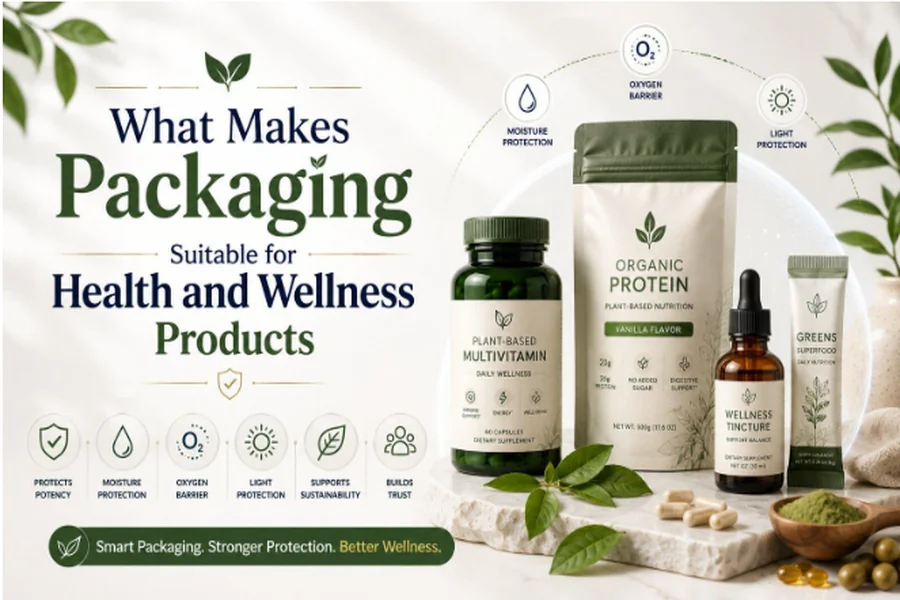
When it comes to health and wellness packaging, it’s not a branding thing. Packaging has a direct impact on any supplement, vitamins, powders, oils, or personal care product from the manufacturing line all the way to the customer’s shelf—where the product must remain safe, potent, and compliant. An attractive box is useless if the product inside is not as presentable as it was when it went into the box.
From material science and regulatory compliance to format selection and sustainability, this guide explains exactly why packaging that’s suitable for health and wellness products is important, and helps brands avoid making guesses.
- Why Packaging Choice Is a Product Safety Decision, Not Just a Branding One
- The link between packaging and product integrity
- What happens when packaging fails
- Core Criteria That Define Suitable Health and Wellness Packaging
- How Packaging Materials Affect Product Protection
- Rigid vs. flexible packaging: protection trade-offs
- Common material choices
- Choosing the Right Packaging Format by Product Type
- Sustainability Without Compromising Product Safety
- Design and Labeling Considerations That Build Consumer Trust
- Common Packaging Mistakes That Compromise Health and Wellness Products
- How to Evaluate a Packaging Supplier for Health and Wellness Products
- FAQs
- What packaging is best for supplements and vitamins?
- Does flexible packaging protect products as well as rigid packaging?
- What makes packaging “tamper-evident”?
- How does packaging affect the shelf life of health products?
- Are custom pouches suitable for powders and probiotics?
- What regulations apply to health and wellness product packaging?
- Conclusion
Why Packaging Choice Is a Product Safety Decision, Not Just a Branding One
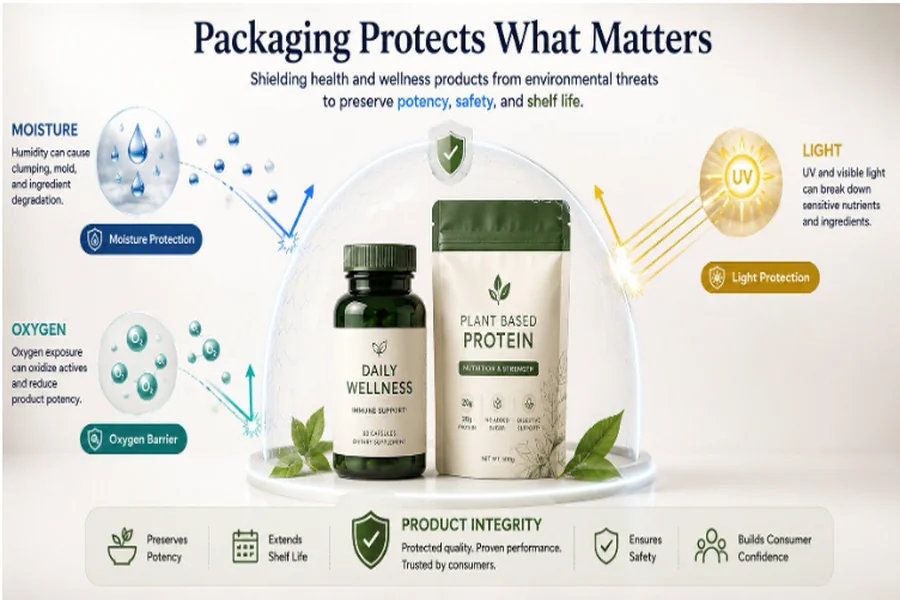
Health products are more sensitive products compared to a typical consumer product. Probiotics, active botanicals, essential oils and nutraceutical powders may be sensitive to light, humidity and air and their efficacy or shelf life may be reduced. The first line of defence in this regard is packaging, which ensures that this sensitivity is well protected.
The link between packaging and product integrity
Packaging is important for the integrity of the product because of its ability to protect it from environmental stresses. If seals are weak, or there are materials that are porous to oxygen and moisture, or incompatible plastics, oxygen and moisture can leak in before the end of the expiration date and destroy the active ingredients.
What happens when packaging fails
Packaging blunders don’t just affect the appearance; consequences exist:
- A decrease in strength in supplements and vitamins.
- Microbial contamination of Powder or Topical form.
- Recalls or reformulation, which are expensive.
- Loss of confidence from customers and repeat sales
Core Criteria That Define Suitable Health and Wellness Packaging
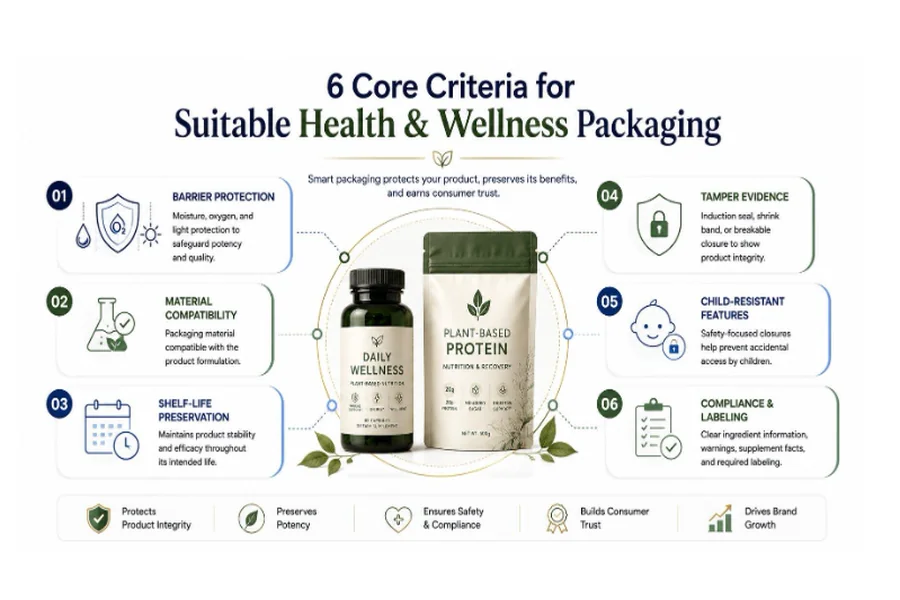
Not every packaging will be as effective as the others for this category. There are a few basic requirements for proper packaging for wellness products:
- Barrier protection: The lining prevents the material from being exposed to moisture, oxygen, and light.
- Material compatibility: The active ingredient(s) in the formulation in question.The materials that are compatible with the active ingredients to be packaged.
- Shelf life preservation: Shelf life preservation is the most important one that ensures product stability throughout the product life cycle.
- Tamper-evidence and child-resistant features: especially for supplements and topicals
- Compliance with regulations and labelling: supplement facts panels and necessary labelling warnings
Brands that don’t take these as a checklist, but rather as part of the product design, will save the majority of product failures.
How Packaging Materials Affect Product Protection
The bulk of the protection work is in the selection of materials.
Rigid vs. flexible packaging: protection trade-offs
Glass or HDPE bottles can be used to hold liquids and capsules and are structurally strong. But flexible packaging is gaining traction in this arena, as it can deliver the same — if not better — barrier protection and saves on the amount of material used, shipping weight, and shelf space. It is adaptable and is a good choice for powders, single-dose, and custom shapes.
Common material choices
- Capsules, tablets and soft gels for oils, tinctures and supplements containing a liquid form of the herb.
- Packaging films for powders and probiotics based on foils or several layers of barrier films.
- Capsule and tablet moisture control bottles, made of HDPE (high-density polyethylene)
- The films are able to be laminated together to provide barrier properties and be flexible with low weight.
The level of protection, cost and sustainability depends on the sensitivity and shelf-life of the product and the different materials offer different levels of protection.
Choosing the Right Packaging Format by Product Type
Health product packaging doesn’t fit all. It is very much dependent on the form of the product, which will determine the correct format.
- Powders and supplements – stand-up pouches or sachets (must have good moisture barrier)
- Blister packs/bottles with humidity control desiccants — to pack capsules and tablets; desiccants — to control humidity in capsules and tablets;
- Foam or liquids — airless pumps, droppers or amber glass bottles to reduce the amount of light that gets in
- Topicals and personal care — jars, tubes or dispensers which balance the need for usability and protection of the product.
Custom Pouches are a great solution for brands with multiple SKUs and product variants; they can be designed to be interchangeable between formulas and sizes, and yet still look and perform as if it was a single family.
| Product Type | Recommended Format | Primary Protection Need |
| Powders & supplements | Stand-up pouches, sachets | Moisture barrier |
| Capsules & tablets | Blister packs, HDPE bottles | Humidity control |
| Liquids & oils | Airless pumps, amber glass, droppers | Light & oxidation protection |
| Topicals & personal care | Jars, tubes, dispensers | Contamination & usability |
Sustainability Without Compromising Product Safety
Within this category, sustainability is a true purchasing driver, but is not a purchase criterion that can be compromised by compromising product protection.
- Recyclable and post-consumer recycled materials are now providing better service than they did before, as a barrier.
- The right sizing of packaging makes it possible to minimise waste without compromising protection.
- While some materials are considered green, there are trade-offs to consider, such as moisture and/or oxygen barrier properties, which require testing before making the transition.
The purpose is not to pick between Sustainability and Protection; it’s to find materials that are designed to provide both.
Design and Labeling Considerations That Build Consumer Trust
Packaging is a medium of communication.
- Adding clarity of ingredients and certifications instantly helps establish trust and credibility.
- Portion control and dosing clarity help consumers build confidence and use the product properly
- Neat, clean layouts assure buyers of safety and quality when they are health-conscious consumers.
With health and wellness products in particular, consumers see transparency as a gauge of the product’s trustworthiness, putting packaging on a functional level, rather than aesthetic.
Common Packaging Mistakes That Compromise Health and Wellness Products
Even top brands are guilty of doing some of the same things that we do:
- Underestimating sensitivity: Not performing barrier testing and assuming a product is shelf-stable based on a lack of knowledge of sensitivity
- Late label compliance review: having to re-print labels because of late compliance review
- Prioritizing looks over performance: Rather than focusing on protection standards, Prioritising looks and performance of the material — choosing material for the looks, but not verifying the protection standards.
All these errors can be avoided if the product formulation team is informed earlier about the packaging team.
How to Evaluate a Packaging Supplier for Health and Wellness Products
As with the selection of the material, choice of the right supplier is as important.
- Request a history of certifications and compliance for materials for which the records have been retained.
- Ask for proof of stability and barrier testing, as well as marketing claims
- Ensure the supplier is able to support multiple SKUs without impacting consistency.
A supplier with health and wellness product packaging expertise will be more apt to alert you to compliance/compatibility concerns before they get costly.
FAQs
What packaging is best for supplements and vitamins?
It depends on the form it is in. Capsules and tablets usually work well in an HDPE bottle or blister pack; powders work well in foil-lined pouches or sachets, which prevent moisture and oxygen from entering.
Does flexible packaging protect products as well as rigid packaging?
Modern flexible packaging, especially the multi-layer barrier film, can offer the same or better moisture and oxygen barrier, but with less material than rigid packaging.
What makes packaging “tamper-evident”?
Tamper evident packaging: Packaging that gives information on whether the product has been opened or not, such as induction seals, shrink bands, breakable closures etc.
How does packaging affect the shelf life of health products?
Effectively prevents losses of the active ingredient from moisture, oxygen and light degradation over time. Without proper barrier protection it can be a considerable loss in shelf life.
Are custom pouches suitable for powders and probiotics?
Yes. Powders and probiotics, which require good moisture and oxygen barrier properties, are usually packaged in Custom Pouches with foil or multi-layer barriers, and are still light and flexible.
What regulations apply to health and wellness product packaging?
Specific requirements vary depending on the product category, and may involve such requirements as supplement facts panels, ingredient disclosure, warning statements and child-resistant packaging (where applicable).
Conclusion
The right health and wellness packaging does all these at once: safeguards product integrity, offers the proper shelf life, meets with regulatory recommendations and conveys trust. It’s not a finishing process that is added after the product is developed; it’s a functional decision that affects the performance of the product from production to purchase and how the consumer views the quality of the product before he or she opens it.
Brands that think about packaging in this way – considering barrier protection, material compatibility, and compliance along with design – will not experience expensive failures, protect their customers, and foster greater confidence in their products over the long term. Correct packaging from the outset is much more cost-effective than correcting after a recall, compliance, or customer trust problem.
