
 Steve Wiideman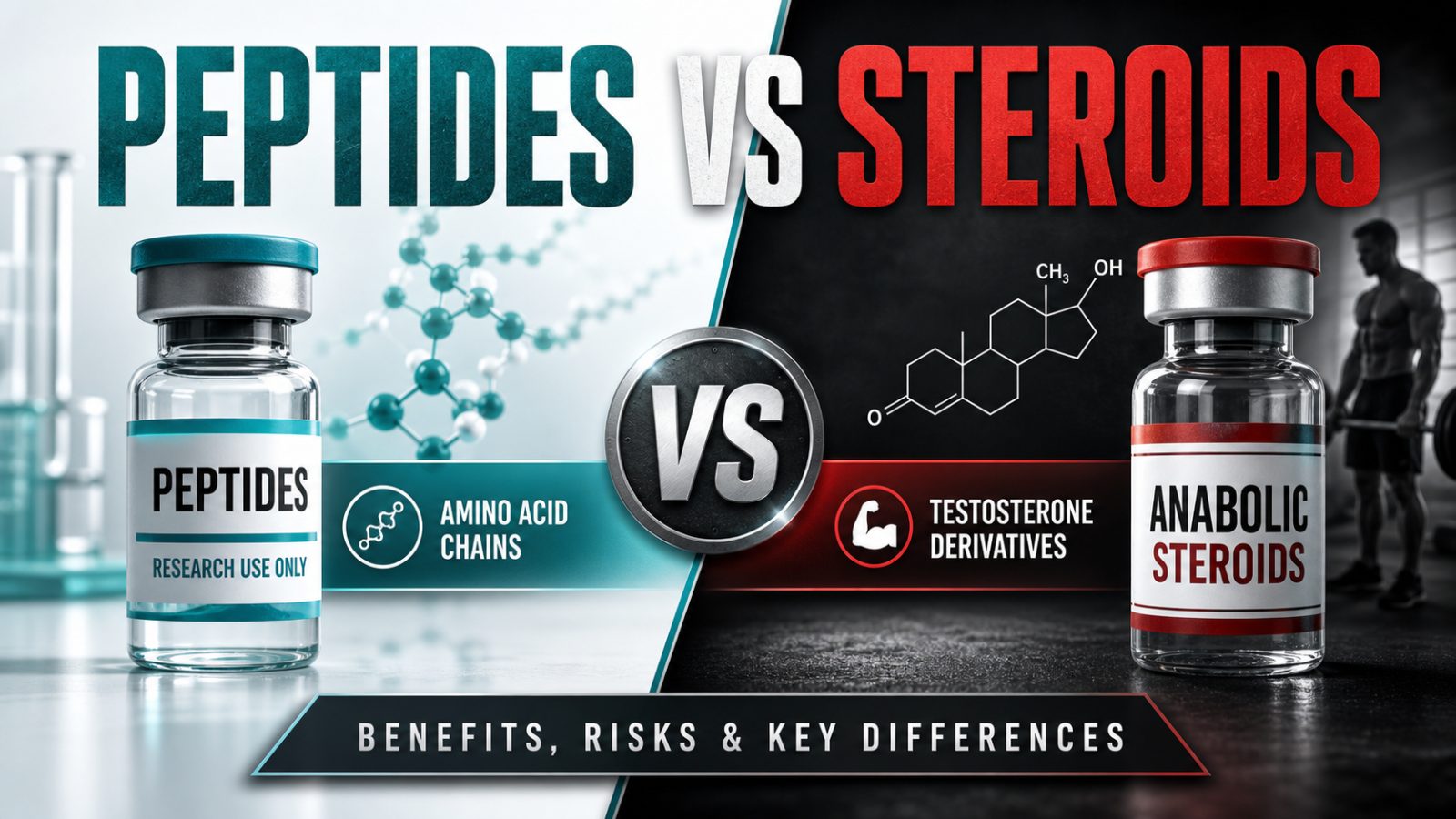
Explore Peptide Research Options
| Medical and research notice: This article is educational and does not recommend nonmedical steroid use or unapproved peptides. Prescription medicines should be used only under qualified clinical supervision. Research-use compounds are not intended for human consumption. |
Peptides and anabolic steroids are often grouped together in fitness conversations, but they are fundamentally different categories. Peptides are short chains of amino acids. The category includes natural signaling molecules, FDA-approved peptide medicines, compounded products, and unapproved laboratory compounds. Anabolic-androgenic steroids are testosterone-related drugs that act primarily through androgen receptors.
Those definitions matter because neither category can be judged by one blanket claim. An approved peptide medicine prescribed for a diagnosed condition is not equivalent to an unapproved research peptide sold online. Likewise, medically prescribed testosterone is not equivalent to nonmedical high-dose anabolic steroid misuse. The safest comparison separates chemistry, intended use, evidence, regulation, and risk.
Quick Answer
Peptides are amino-acid chains that can signal highly specific biological pathways, while anabolic steroids are testosterone derivatives that activate androgen receptors across many tissues. Steroids generally have a more direct and predictable anabolic effect on muscle, but misuse carries established cardiovascular, hormonal, reproductive, psychiatric, liver, and kidney risks. Peptide effects vary dramatically by compound; some are approved medicines, while many performance-oriented peptides have limited human evidence and uncertain product quality.
Peptides vs Steroids at a Glance
| Category | Peptides | Anabolic Steroids |
| Basic structure | Short amino-acid chains | Testosterone-related steroid molecules |
| Primary action | Depends on the peptide and receptor | Activates androgen receptors |
| Muscle effect | Highly variable and often indirect | Direct anabolic and androgenic effects |
| Evidence | Ranges from approved drugs to early research | Established medical uses and extensive misuse data |
| U.S. legal status | Varies by compound and intended use | Many anabolic steroids are Schedule III controlled substances |
| Main concern | Evidence, identity, contamination, and immunogenicity | Cardiovascular, endocrine, reproductive, psychiatric, liver, and kidney harm |
What Are Peptides?
A peptide is a chain of amino acids joined by peptide bonds. Human biology uses peptides as hormones, messengers, and regulatory molecules. Insulin is a familiar example of a peptide medicine, and several other approved drugs use peptide structures or mimic peptide hormones. This means the word “peptide” does not automatically imply experimental, athletic, or unsafe.
The confusion comes from a separate online market for compounds promoted for muscle growth, fat loss, recovery, tanning, sleep, or longevity. Some have preliminary laboratory or animal data. Others have limited clinical research, no approved indication, or no meaningful human exposure data. FDA materials identify potential concerns for certain compounded peptide substances, including immune reactions, aggregation, peptide-related impurities, and inadequate safety information.
Peptides can also be difficult to characterize and manufacture. A purity percentage does not independently prove the correct molecular identity, dose, sterility, endotoxin status, stability, or suitability for human use. Those distinctions are especially important when a product is labeled for research use only.
What Are Anabolic Steroids?
Anabolic-androgenic steroids are synthetic substances related to testosterone. “Anabolic” refers to tissue-building effects, while “androgenic” refers to effects associated with male sex characteristics. Clinicians may prescribe certain steroids or testosterone products for legitimate conditions, but nonmedical use commonly involves different goals, doses, combinations, and monitoring.
Anabolic steroids bind to androgen receptors and change gene transcription in responsive tissues. This can increase muscle protein synthesis, red blood cell production, strength, and lean mass. The same receptor activity can also suppress the body’s own hormone production and affect the heart, blood vessels, brain, skin, liver, kidneys, reproductive system, and other tissues.
In the United States, anabolic steroids are Schedule III controlled substances. Possession or distribution outside lawful medical channels can create legal consequences in addition to health risks.
How Their Mechanisms Differ
- Peptides act through compound-specific signals
- Steroids share a clearer androgen pathway
- Potential peptide risks
- Potential anabolic steroid risks
- “Peptides are natural, so they are safe.”
- “Steroids only cause problems at extreme doses.”
- “A certificate of analysis makes a research peptide medical grade.”
- Are peptides steroids?
- Do peptides build as much muscle as steroids?
- Can peptides and steroids be combined?
- Which is better for recovery?
Peptides act through compound-specific signals
There is no single peptide mechanism. One peptide may mimic a natural hormone, another may bind a growth-hormone-related receptor, and another may be studied for inflammatory or tissue-signaling pathways. Effects depend on sequence, receptor selectivity, route, exposure, metabolism, and the quality of the evidence for that exact molecule.
Steroids share a clearer androgen pathway
Anabolic steroids differ in potency, metabolism, oral availability, and balance of anabolic and androgenic activity, but they broadly converge on androgen-receptor signaling. That makes their muscle-building effects more predictable than those of the broad peptide category. It also creates class-related harms that are well documented.
Muscle Growth and Performance
For muscle gain, anabolic steroids have the stronger and more direct evidence of effect. That is not an endorsement. The same pharmacology that increases muscle and strength can disrupt natural testosterone production, fertility, cholesterol, blood pressure, cardiac structure, mood, and other systems. Larger gains do not imply a favorable risk-benefit balance for a healthy person.
Peptide marketing often uses terms such as recovery, growth-hormone support, body composition, or tissue repair. The actual evidence varies by compound. A laboratory signal, animal study, or change in a biomarker does not prove meaningful muscle growth or injury recovery in humans. Claims should be tied to the exact peptide, population, formulation, and study design.
Recovery and Injury Claims
Some unapproved peptides are promoted for tendon, ligament, muscle, or gastrointestinal repair. For several popular research compounds, human evidence is sparse or absent. Animal findings may justify further study, but they cannot establish clinical effectiveness, safe dosing, or long-term outcomes.
Anabolic steroids may influence muscle recovery and training capacity, but they do not make an injury structurally safe. Faster strength gains can increase load before connective tissue is prepared for it. Pain suppression, rapid return to training, or improved performance can mask the need for diagnosis and rehabilitation.
Side Effects and Safety Risks
Potential peptide risks
- Unknown or limited human safety data for many unapproved compounds.
- Incorrect identity, concentration, or labeling in poorly regulated products.
- Contamination, sterility failures, endotoxin, degradation, or storage problems.
- Immune reactions or immunogenicity related to the peptide or impurities.
- Compound-specific metabolic, cardiovascular, endocrine, or organ effects.
- Interactions that have not been adequately studied.
Potential anabolic steroid risks
- High blood pressure, unfavorable cholesterol changes, blood clots, heart attack, and stroke risk.
- Suppressed natural hormone production, testicular shrinkage, infertility, and breast tissue growth in men.
- Menstrual changes, facial hair growth, voice deepening, and other virilizing effects in women.
- Mood changes, irritability, aggression, depression, and dependence.
- Liver injury, particularly with certain oral anabolic steroids.
- Kidney stress or damage, acne, hair loss, and increased injury risk.
| Emergency warning: Chest pain, severe shortness of breath, fainting, one-sided weakness, a severe headache, jaundice, suicidal thoughts, or signs of a serious allergic reaction require urgent medical evaluation. |
Hormones, Fertility, and Long-Term Effects
Anabolic steroid exposure can suppress the hypothalamic-pituitary-gonadal axis. Recovery after discontinuation is variable, and some users experience prolonged low testosterone, infertility, sexual dysfunction, fatigue, or depression. In women, some androgenic changes may be irreversible. Adolescents face additional risks because hormonal disruption can affect development and growth.
Peptide endocrine effects depend on the molecule. Compounds that alter growth-hormone, insulin-like growth factor, appetite, glucose, reproductive, or adrenal pathways can create systemic changes even when advertised as targeted. Long-term outcome data are often the weakest part of the evidence for unapproved peptides.
Legality and Sports Rules
Legality is not determined by whether a substance is called a peptide. Approved peptide medicines generally require appropriate prescribing and dispensing. Compounded drugs are not FDA approved, and FDA does not verify their safety, effectiveness, or quality before marketing. Research-use materials are not a lawful substitute for approved medicines intended for patients.
Anabolic steroids are controlled substances under U.S. federal law, with limited legal access through valid medical prescribing. Athletic organizations may prohibit anabolic agents, peptide hormones, growth factors, secretagogues, and related substances. Competitive athletes should check the current rules that apply to their sport rather than relying on a product label or seller.
Are Peptides Safer Than Steroids?
Not as a blanket statement. Some FDA-approved peptide medicines have well-characterized benefits and risks for specific patients. Some unapproved research peptides have so little human evidence that their risk cannot be quantified. Steroid misuse has a more established and substantial harm profile, but uncertainty is not the same as safety.
The meaningful question is not “peptide or steroid?” It is: What exact compound is involved, is it approved for the intended purpose, what evidence supports it, who manufactured or compounded it, what monitoring is required, and does a qualified clinician believe the benefits outweigh the risks for this individual?
Common Myths
“Peptides are natural, so they are safe.”
Natural biological signaling does not guarantee that a synthetic copy, modified sequence, concentrated exposure, or untested route is safe. Insulin is natural to the body, yet incorrect use can be life-threatening.
“Steroids only cause problems at extreme doses.”
Risk varies with the compound, dose, duration, route, genetics, health status, and co-use of other substances. There is no universal nonmedical steroid regimen proven safe for everyone.
“A certificate of analysis makes a research peptide medical grade.”
A certificate can provide useful batch data, but its value depends on sample identity, laboratory independence, methods, complete results, and chain of custody. It does not convert a research product into an FDA-approved medicine.
Frequently Asked Questions
Are peptides steroids?
No. Peptides are amino-acid chains. Anabolic steroids are testosterone-related steroid molecules. They differ in structure, receptors, metabolism, regulation, and effects.
Do peptides build as much muscle as steroids?
The broad peptide category does not have one muscle-building effect. Anabolic steroids have a more direct and established effect on muscle and strength, along with substantial health risks. Claims for any peptide must be evaluated compound by compound.
Can peptides and steroids be combined?
This article does not recommend combining them. Stacking substances increases uncertainty, interactions, and the difficulty of identifying the cause of an adverse effect.
Which is better for recovery?
There is no universal answer. Injury recovery depends on an accurate diagnosis, appropriate loading, rehabilitation, sleep, nutrition, and time. Neither category should replace evidence-based medical care.
Final Verdict
Peptides and anabolic steroids are not interchangeable shortcuts. Peptides range from established medicines to speculative research compounds, while anabolic steroids have direct androgenic effects and well-documented harms when misused. Compare exact substances, approved uses, evidence, product quality, legal status, and medical oversight rather than relying on category labels or marketing promises.
