
 James
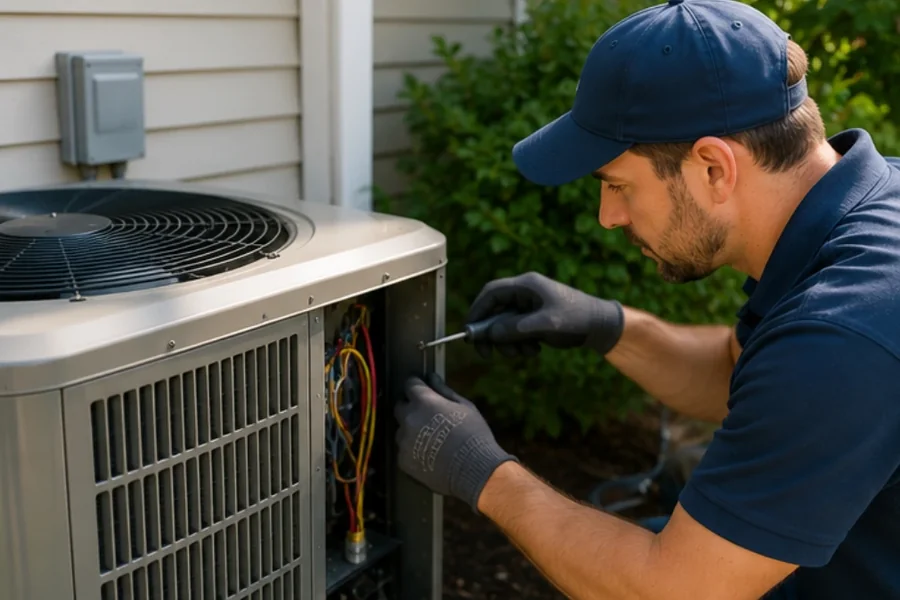
The first complaint we ever get about a struggling air conditioner is almost never about the compressor. It’s about a number on a screen. Someone in Atwater texts me a photo of a thermostat reading 84 at 6 p.m. and asks whether the unit is dying. Nine times out of ten, it’s not dying. It’s drowning.
Every cooling system has a load ceiling, and yours hits it long before the parts wear out. A local technician repairing HVAC in Atwater, CA will tell you the same thing: most of the calls that end in a repair price could have ended in a duct seal or a shade sail. The compressor gets blamed. It rarely deserves it.
I’m going to show you how to find your own ceiling, in order of what actually costs you money.
Your system doesn’t fail all at once, it fails in layers
Picture a 1,600 square foot stucco house off Bellevue Road with an aging roof and west-facing glass. The AC is a 3-ton unit rated for the square footage, and on paper it’s sized correctly. What the sizing sheet didn’t account for is a 140-degree attic, a duct run that travels twenty-two feet through that attic before it reaches a bedroom, and a sliding door that bakes from 3 p.m. onward.
That system isn’t undersized. It’s overworked. There’s a real difference, and it decides whether you spend Tuesday evening on the couch or on the phone with a dispatcher.
The ladder goes like this:
- Gain. Heat enters the house through the roof, walls, and glass.
- Loss. Cold air exits through gaps in the ducts, weatherstripping, and door sweeps.
- Delivery. Whatever survives the first two steps has to reach the room evenly. It often doesn’t, because the return path is blocked.
- Demand. The unit has to cover all of the above, and it can only move so much air per minute.
When I walk a house, I check those four in reverse. Demand is the symptom you feel. Delivery and loss are usually the cause. Gain is the one you fix last, and yet it’s the one most homeowners attack first with a bigger unit. I’d put attic insulation above a replacement every single time. A right-sized system in a leaking envelope just leaks faster.
Do you know where your air is actually going?
Roughly a quarter of the air you pay to cool never reaches a room you occupy. That’s the working number the Department of Energy uses for typical duct loss, and in homes with ducts running through a hot attic it can be worse. If your ducts run through a 140-degree attic and they leak 25 percent, you’re cooling the attic. Then you’re paying for it on a July statement with a tier-three rate attached.
You can test this yourself without tools. On a hot afternoon, stand under a supply register in the room that never gets cool. Hold your hand up. If the airflow feels weak and the grille itself is warm to the touch, the problem is upstream, not in the bedroom. Then go find the return grille. If it’s covered by a rug, a bookshelf, or a dresser, move the furniture. I once cleared a return behind a couch and dropped a living room three degrees without touching the system. That’s the entire job some days.
Match the shade to the clock, not the room
Here’s the thing about Central Valley sun: it doesn’t move around the house evenly, and a lot of shade advice ignores that. Planting a shade tree is great news for the year 2038. In the meantime, cloth works.
Track where the sun lands at 4 p.m., then at 6 p.m. A west and southwest exposure collects the worst of it, and a cheap exterior solar screen over those two windows cuts radiant gain without making the room feel like a cave the way interior blinds can. Interior blinds catch heat that’s already inside the glass. Exterior screens stop it before the glass ever warms up. If you’re choosing one, choose exterior.
A patio cover earns its money by September. So does film on a west-facing slider, though film can look muddy if you pick a shade too dark for the room. Stay lighter than you think you need.
Five checks you can run this weekend
None of these require a tool bag. Do them in this order, because cheap fixes first is how you avoid paying for a diagnosis you didn’t need.
- Change the filter, then check the filter slot. A clogged filter starves the air handler and can freeze the evaporator coil, which mimics a dying system perfectly. Dirty filter first, always, before you call anyone.
- Feel the grilles. Weak airflow plus a warm grille usually points to ducts or the return path, not the outdoor unit.
- Shade the west glass. Screens, awning, film. Pick one and install it before the next heat wave.
- Move the thermostat off the hot wall. A thermostat mounted on a sun-baked interior wall reads the wall, not the room. It’ll keep running until the hallway hits the set point, which can be twenty minutes after the bedroom already did. Thermostat placement is boring and it matters constantly.
- Write down the set point and the time it takes to get there. Ten minutes, five days in a row. That notebook page is the most useful thing you’ll hand a technician, because it turns a vague complaint into a measured one.
The machines around your house changed the math
Something most people miss is that an AC shares a house with everything else that draws power, and those loads have grown. The National Institute of Standards and Technology works on the measurement standards behind home electrical systems, and the headline is simple enough for a homeowner: the home’s wiring has a total capacity, and your appliances compete for it. A pool pump, an EV charger, and a refrigerator cycling on at the same moment all pull from the same panel. If voltage sags when the AC kicks on, lights in the kitchen flicker for a second, and that’s your panel telling you something. It’s not an emergency. It is a conversation worth having before the summer gets worse.
Run a ceiling test before you buy a bigger unit
Find the hottest day in the forecast, set the thermostat to 78, and log the indoor temperature hourly from noon to eight. That’s your ceiling. Now here are three houses, all 1,600 square feet, all with the same 3-ton system, all with different resolutions.
| House | Ceiling it hits | What actually fixed it
|
|---|---|---|
| Older downtown bungalow, pier and beam | 86 by 5 p.m. | Attic insulation top-up and duct sealing |
| Mid-2000s build near Bellevue Ranch | 82 by 4 p.m. | Exterior screens plus a cleared return grille |
| Renovated house with a new patio addition | 80 by 7 p.m. | Manual J load review, then a system change |
Notice the third one. That’s the house that genuinely needed different equipment, and it’s the only one. Two out of three paid for envelope work instead of hardware, and their bills dropped without a single new part. If your ceiling holds under about a ten degree gap from the set point, the equipment is probably fine and the house is the problem.
Here’s my honest prediction for most people reading this: your unit is working, harder than it should have to, and no one has ever shown you where the load comes from. Do the five checks. Log a week of temperatures. Then, when you do call someone, hand them the notebook page and ask specifically about ducts, insulation, and airflow before anyone quotes you a replacement. Two out of three of those conversations end with a seal, a filter, or a screen instead of a condenser. What’s your ceiling right now?
