
 James
James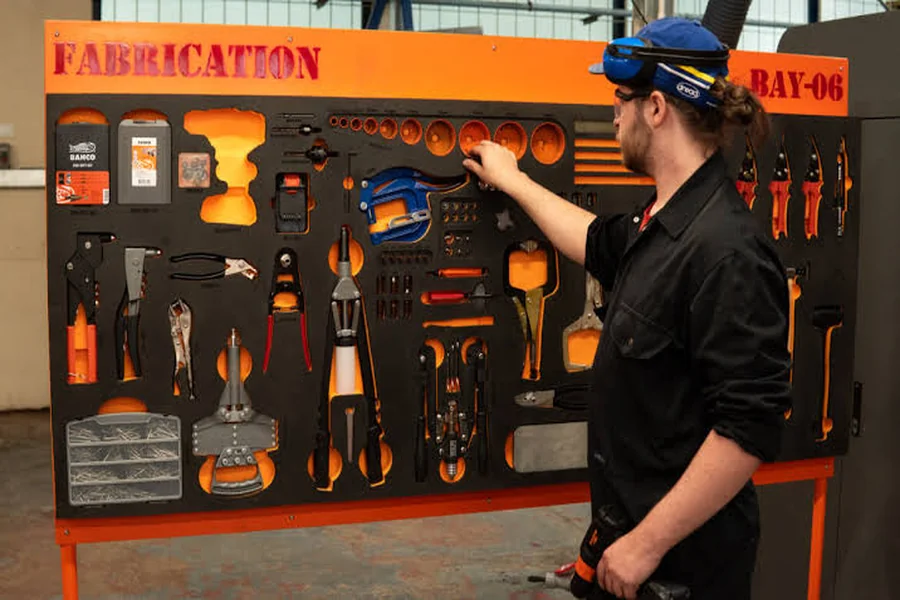
Walk into any job site that requires tools and tool storage solutions like garages, workshops, hangars, equipment repair stations, and MRO facilities, and you can usually tell when things are starting to get away from people. It is not always dramatic. Sometimes it is a technician opening three drawers before finding what they need. Sometimes a tool is missing from the box and you can’t tell which one, and nobody is quite sure where to start putting things in order. Small moments, yes—but in the wrong environment, they can quickly become expensive ones.
That is where custom shadow foaming earns its place. Not as a cosmetic upgrade for a toolbox, but as a practical way of bringing order to equipment that people depend on every day.
1. Aviation and Aerospace: Making FOD Prevention More Visible
In aerospace maintenance, organization is not simply about making a toolbox look professional. It becomes part of the discipline surrounding every maintenance task. Custom shadow foaming for tools give each tool a defined position, making omissions immediately noticeable rather than leaving technicians to rely entirely on memory.
For an MRO or defense operation, that can mean designing foam around the exact tool inventory used for a particular aircraft, engine, or maintenance procedure.
- High-contrast layers make missing tools easier to identify.
- Tool outlines provide an immediate visual reference during checks.
- Foam layouts can be adapted as maintenance requirements evolve.
- Engraved identifiers can support controlled tool accountability.
The real value lies in making the correct action intuitive. A technician should not have to stop and mentally reconstruct where something belongs.
2. Automotive and Racing: Tool Organization That Keeps Pace
In time-critical maintenance environments like aeroplane line maintenance, express bays, and professional racing pits, clutter is a glaring issue that visibly slows down technicians and frustrates service seekers. To combat this, maintenance crews are expected to maintain zero tolerance for delays during tight service windows.
And when a technician can’t find a tool, the problem is not necessarily that the tool is missing. Sometimes it is right there, somewhere under five others. A custom foam layout can be designed around the way technicians actually move through a job.
Technology-based foam solutions allow organizers to customize their tool storage around the specific tools, sequence of operations, and ergonomics of the job, rather than adapting to a generic toolbox. Socket sizes can follow a logical sequence, frequently used tools can sit within immediate reach, and specialist equipment can have its own clearly defined position.
That matters particularly where:
- Different teams share equipment.
- Tool inventories change between events.
- Technicians need rapid visual confirmation.
- Cases travel repeatedly between workshop and track.
Good customization is therefore less about cutting foam into attractive shapes and more about understanding how the crew works under pressure.
3. Field Engineering: Movement is Part of The Job, and Tool Protection is Key
Tools experience a very different life when they spend their days moving between sites. A workshop case can stay in one place. A field engineer’s case rarely gets that luxury. It may spend hours in a vehicle, get carried through industrial sites, opened outdoors, packed away quickly, and taken somewhere else before the day is over.
Custom-molded foam creates a controlled environment for that equipment. Each item has a designated cavity that reflects its size and working purpose, while the case itself becomes easier to manage.
For mobile technicians, thoughtful design can account for:
- Frequently transported diagnostic equipment.
- Delicate or precision instruments.
- Compact cases where every millimeter matters.
- Tool combinations specific to recurring service calls.
The best solution begins with listening to the technician’s routine. What gets used first? What needs protection? What can be removed without taking half the case apart? Those questions produce a much more useful result than a standard insert ever could.
4. Industrial and High-Security Manufacturing: Accountability by Design
Large industrial operations introduce another challenge: equipment may pass between technicians, shifts, departments, or secured working areas. When valuable tools disappear into a crowded drawer, determining where they went can become unnecessarily difficult.
A customized foam system builds accountability directly into the storage by leveraging foam layouts that create a clear visual record of missing or present tools. This system can be enhanced using:
- Tool codes: Unique alphanumeric IDs assigned to each tool for quick inventory tracking.
- Labels: Text or color-coded markers applied directly to the foam or tool slots.
- Engraved identifiers: Permanent markings laser-etched onto tools or shadow boards to verify ownership.
- Matching positions: Precision-cut foam shapes that only fit a specific tool in a specific spot.
For high-security environments, that can complement established inventory and handover procedures rather than replacing them.
It is particularly useful when:
- Multiple crews share specialized equipment.
- Tool inventories must be checked at shift changes.
- Expensive instruments require controlled handling.
- Equipment moves between production zones.
Here, customization becomes a management tool as much as a storage solution.
In essence, the strongest custom foaming solutions are not produced from measurements alone. They come from understanding the environment, the equipment, the people, and the consequences of poor organization. Those details shape a worthwhile custom tool storage solution. The technology behind custom shadow foam for tools matter, but so does the expertise behind the design. When a provider listens carefully and understands the environment, custom shadow foaming can become a practical part of better-run operations—not just a smarter-looking way to store tools.
