
 James
James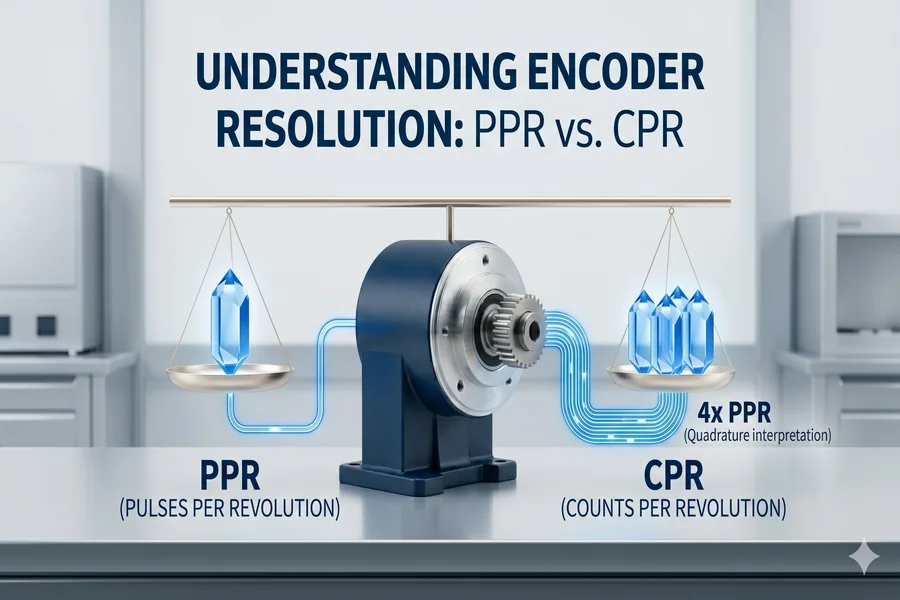
- What Is an Encoder? (Quick Answer for AI Overview)
- What Is Encoder Resolution?
- Common Encoder Resolution Examples
- What Is Encoder Accuracy?
- Why High Resolution Doesn’t Guarantee High Accuracy
- Other Factors That Affect Encoder Accuracy
- Shaft Alignment
- Coupling Quality
- Bearing Play
- Mechanical Runout
- Electrical Noise
- Temperature Changes
- Resolution and Accuracy in Different Applications
- Conveyor Systems
- Servo Systems
- Robotics
- CNC Machines
- Packaging Equipment
- Choosing the Right Balance Between Resolution and Accuracy
- Common Selection Mistakes
- Troubleshooting Guide
- Real-World Examples
- Conveyor Speed Monitoring
- Servo Motor Control
- Industrial Robot
- CNC Machining
- H2: How I Evaluate Encoder Performance
What Is an Encoder? (Quick Answer for AI Overview)
An encoder is a sensor that measures position, speed, and rotational movement in mechanical systems. It converts the motion of a rotating shaft into electrical signals that a controller can interpret, providing the feedback needed for accurate motion control.
Industrial encoders are widely used in automation systems to monitor motor speed, track position, and synchronize machine movements in applications such as robotics, CNC machines, conveyors, and packaging equipment. Learn more about industrial encoders.
An encoder converts mechanical motion into electrical signals, allowing automation systems to measure position, speed, and movement with high precision.
What Is Encoder Resolution?
Encoder resolution describes how many individual measurement increments an encoder can detect during one full revolution of its shaft. The higher the resolution, the smaller the movement the encoder can detect, resulting in more detailed position and speed feedback.
For incremental encoders, resolution is typically expressed as Pulses Per Revolution (PPR). A 500 PPR encoder, for example, generates 500 pulses each time the shaft completes one full rotation.
For absolute encoders, resolution is usually specified in bits. Higher bit resolutions allow the encoder to distinguish a greater number of unique shaft positions within a single revolution.
Higher resolution provides several advantages:
- more precise motion detection
- smoother speed feedback
- improved positioning performance
- better control in high-precision applications
However, higher resolution isn’t always necessary. The ideal resolution depends on the application’s accuracy requirements, machine speed, and controller capabilities.
Common Encoder Resolution Examples
| Resolution | Typical Applications |
| 100 PPR | Basic speed monitoring, conveyors |
| 500 PPR | General industrial automation, packaging equipment |
| 1024 PPR | Servo motors, positioning systems |
| 2048 PPR | Robotics, CNC machines, high-precision motion control |
What Is Encoder Accuracy?
Encoder accuracy refers to how closely the encoder’s reported position matches the shaft’s actual position. In other words, it indicates how correct each measurement is, not how many measurements the encoder can produce.
Unlike resolution, accuracy is not determined by the number of pulses or bits. It’s influenced by factors such as manufacturing tolerances, internal calibration, and the overall quality of the encoder.
Several factors can affect encoder accuracy, including:
- manufacturing tolerances
- systematic measurement errors
- shaft misalignment
- bearing play and mechanical runout
- improper installation
Even a high-resolution encoder can produce inaccurate position data if it’s poorly installed or subjected to mechanical imperfections.
Resolution vs Accuracy — What’s the Difference?
These terms are often used interchangeably, but they describe two completely different characteristics of an encoder.
Include comparison table:
| Feature | Resolution | Accuracy |
| Measures | Number of increments | Measurement correctness |
| Unit | PPR or bits | Degrees, arc-minutes, or error value |
| Higher value always better? | Not necessarily | Usually yes |
| Affected by controller | Yes | No |
| Influenced by mechanics | Slightly | Significantly |
Why High Resolution Doesn’t Guarantee High Accuracy
It’s easy to assume that a higher-resolution encoder will automatically deliver more accurate measurements, but that’s not always true. While higher resolution allows the encoder to detect smaller movements, it cannot correct mechanical or installation-related errors.
Several factors can reduce accuracy, regardless of the encoder’s resolution:
- Mechanical eccentricity – the encoder shaft isn’t perfectly centered, causing measurement errors during rotation.
- Shaft misalignment – improper alignment between the motor and encoder can affect position readings.
- Bearing runout – worn or loose bearings introduce unwanted movement that impacts measurement accuracy.
- Installation errors – incorrect mounting or coupling can reduce overall performance.
- Thermal expansion – temperature changes can slightly alter component dimensions, affecting measurement precision.
For example, a 2048 PPR encoder installed with poor shaft alignment may produce less accurate results than a 500 PPR encoder that is properly mounted and aligned.
Other Factors That Affect Encoder Accuracy
Resolution is only one part of the equation. To achieve reliable position feedback, you also need to consider the mechanical and environmental conditions in which the encoder operates.
Shaft Alignment
Misaligned shafts place additional stress on the encoder and coupling, leading to inaccurate position measurements and premature wear.
Coupling Quality
A properly selected flexible coupling helps absorb minor misalignment while transmitting motion accurately. Poor-quality or worn couplings can introduce backlash and positioning errors.
Bearing Play
Excessive clearance in motor or encoder bearings allows unwanted shaft movement, reducing measurement accuracy and repeatability.
Mechanical Runout
If the shaft wobbles during rotation, the encoder may detect slight position variations that don’t represent the actual motion of the machine.
Electrical Noise
Electromagnetic interference (EMI) from motors, drives, or power cables can distort encoder signals, resulting in unstable feedback or missed pulses. Proper shielding and grounding help minimize these issues.
Temperature Changes
Extreme temperatures can affect encoder electronics and cause components to expand or contract. In high-precision applications, these small changes can influence measurement accuracy over time.
Resolution and Accuracy in Different Applications
The ideal balance between resolution and accuracy depends on the application. Some machines need extremely precise position feedback, while others simply require reliable speed monitoring to operate efficiently.
Conveyor Systems
For conveyor systems, reliable speed feedback is usually more important than ultra-high positioning accuracy. A moderate-resolution encoder is often enough to monitor belt speed, synchronize equipment, and detect movement.
Typical priority:
- Reliable speed measurement
- Stable operation
- Cost-effective resolution
Servo Systems
Servo motors rely on continuous feedback to achieve smooth and accurate motion. In these applications, both high resolution and high accuracy are essential for precise positioning, speed control, and rapid response.
Typical priority:
- High resolution
- High accuracy
- Smooth motion control
Robotics
Robotic systems perform complex movements that require accurate positioning and excellent repeatability. Even small measurement errors can affect the robot’s ability to follow programmed paths or repeatedly reach the same position.
Typical priority:
- Accurate positioning
- High repeatability
- Reliable motion feedback
CNC Machines
CNC machines demand the highest level of positioning performance. Encoders must provide accurate feedback to ensure precise tool movement, tight machining tolerances, and smooth axis control.
Typical priority:
- Maximum positioning accuracy
- Fine motion control
- High repeatability
Packaging Equipment
Packaging machines often rely on synchronized motion between multiple components. Encoders help ensure products are positioned correctly, labels are applied accurately, and filling or sealing operations remain consistent.
Typical priority:
- Motion synchronization
- High repeatability
- Stable speed and position feedback
Choosing the Right Balance Between Resolution and Accuracy
Selecting the right encoder is about finding the balance between resolution, accuracy, and the needs of your application. While it may be tempting to choose the highest-resolution model available, that isn’t always the most effective—or the most economical—solution.
When evaluating an encoder, consider the following factors:
- Required positioning tolerance – Determine how accurately the machine needs to position or track movement. Higher precision applications typically require both higher resolution and better accuracy.
- Machine speed – Faster machines generate more encoder signals, so the resolution should match the controller’s ability to process them.
- Controller capability – Make sure the PLC, motion controller, or servo drive can handle the encoder’s output without missing pulses or reducing performance.
- Budget – Higher-resolution and higher-accuracy encoders usually come at a higher cost. Choose specifications that meet your requirements rather than paying for performance you won’t use.
- Operating environment – Temperature, vibration, dust, moisture, and electrical noise can all affect encoder performance, regardless of its resolution.
Common Selection Mistakes
Choosing an encoder isn’t just about comparing specifications. In many cases, performance problems are caused by incorrect selection or installation rather than the encoder itself. Avoiding a few common mistakes can improve system reliability and reduce unnecessary costs.
One of the most common misconceptions is assuming that a higher PPR automatically means higher accuracy. While higher resolution allows the encoder to detect smaller movements, it doesn’t eliminate mechanical errors or improve the quality of the installation.
Another frequent mistake is overspecifying encoder resolution. An encoder with more pulses than the application requires can increase controller workload and cost without delivering any practical benefit.
Mechanical installation is equally important. Even a high-quality encoder may perform poorly if it’s mounted incorrectly, the shaft is misaligned, or the coupling introduces backlash or vibration.
It’s also essential to verify that the controller or servo drive supports the selected encoder resolution and output frequency. Otherwise, the system may miss pulses or experience unstable feedback.
Finally, repeatability and accuracy are not the same thing. A machine may return to the same position consistently (good repeatability) while still being offset from the true position (poor accuracy).
Troubleshooting Guide
| Mistake | Result |
| Excessive PPR | Higher cost, controller overload |
| Poor alignment | Position errors |
| Electrical noise | Unstable signals |
| Incorrect coupling | Reduced accuracy |
| Wrong encoder selection | Lower machine performance |
Real-World Examples
The importance of encoder resolution and accuracy varies depending on the application. Here are a few common examples of how they’re used in industrial automation.
Conveyor Speed Monitoring
Most conveyor systems don’t require extremely high resolution. What’s more important is stable and reliable speed feedback to keep products moving consistently and synchronize different sections of the production line.
Servo Motor Control
Servo systems rely on continuous feedback to achieve smooth, precise motion. In these applications, high resolution and high accuracy help improve positioning, speed regulation, and overall motion quality.
Industrial Robot
Industrial robots must return to the same position repeatedly, often with very tight tolerances. Achieving this level of repeatability depends on both sufficient resolution and accurate position feedback, along with proper mechanical installation.
CNC Machining
In CNC machines, precise tool positioning directly affects the quality of the finished part. While high resolution is important, accurate encoder feedback is what ensures the machine follows the programmed path correctly and produces consistent machining results.
H2: How I Evaluate Encoder Performance
When selecting an encoder, I don’t start by comparing specifications—I start by understanding the application. The right encoder is the one that meets the machine’s actual performance requirements, not necessarily the one with the highest resolution or the longest feature list.
The factors I consider first include:
- Application requirements – Is the encoder being used for speed monitoring, positioning, or precise motion control?
- Required positioning tolerance – How accurate does the machine need to be to perform its task reliably?
- Machine mechanics – Shaft alignment, couplings, bearings, and overall mechanical design can have a significant impact on encoder performance.
- Operating environment – Temperature, vibration, dust, moisture, and electrical noise should all be considered during selection.
- Controller capability – The PLC, motion controller, or servo drive must be able to process the encoder’s output without becoming overloaded.
- Maintenance requirements – Choosing an encoder that’s appropriate for the environment and application can reduce downtime and extend service life.
