
 James
James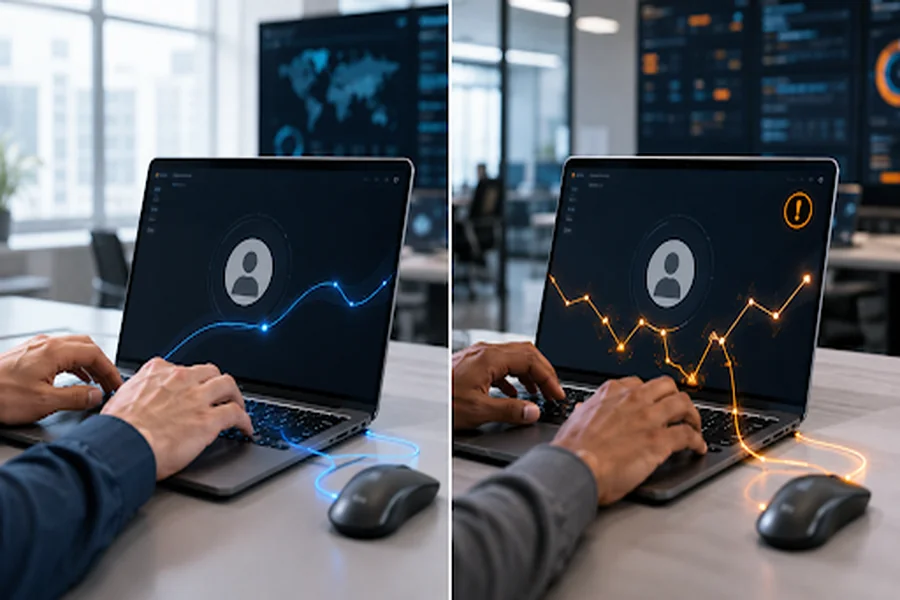

A correct password does not prove that the legitimate account holder remains in control. Credentials can be exposed through phishing, malware, password reuse or a breached database.
Behavioral biometrics examines how a person interacts with a device rather than relying only on what that person knows or possesses. Typing rhythm, cursor movement, touchscreen gestures and navigation habits form patterns. A major deviation may suggest that control of the account has changed hands.
Behavior Can Become an Identity Signal
Physical biometrics relies on stable traits such as a fingerprint or face. Behavioral biometrics examines actions that vary slightly each time. The aim is not to find perfectly repeated movement, but to identify a consistent range of habits.
Keystroke analysis measures intervals between keys, press duration, corrections and typing speed. Mouse analysis may consider movement curves, pauses and acceleration. A phone supplies additional signals through taps, swipes, orientation and motion sensors.
Touchscreen behavior can distinguish users, although accuracy changes across sessions and devices. Behavioral evidence is therefore better suited to supporting established controls than replacing them. Passwords, device records and one-time codes still have important roles.
Software usually converts interactions into numerical features describing timing and movement. The current session can then be compared with an established pattern without retaining complete sentences or every cursor coordinate.
The Profile Develops During Normal Use
A useful model needs enough observations to understand ordinary variation. One session cannot show how typing changes with another keyboard, while travelling or when a phone is held in one hand. The profile becomes more reliable as representative activity accumulates.
Common features include:
- time between consecutive keystrokes;
- duration of key presses;
- cursor speed and direction;
- frequency of corrections and pauses;
- touchscreen swipe length and pressure;
- typical order of account functions.
The model calculates how closely current activity resembles earlier sessions rather than requiring every feature to match. Unfamiliar behaviour should not immediately become the new baseline. Otherwise, an attacker who retains access could influence the model. Updates can be limited to sessions that have passed stronger identity checks.
Risk Builds Across Several Signals
An unusual mouse movement proves little by itself. A new desk, temporary injury or accessibility tool can change familiar behavior. Detection becomes more useful when several signals and the surrounding context point in the same direction.
A recognized device may receive a low initial risk score. That score can rise when typing changes sharply, navigation becomes unusually fast and a sensitive account change follows. An unfamiliar location or network can add further concern.
At a casino online, an account takeover may become visible between the casino lobby and cashier rather than during login. An account that normally opens low-stake slots might suddenly move between blackjack tables, increase its stake, abandon a bonus balance and proceed directly to change the payout method before requesting a withdrawal. The casino can pause that transaction and compare wager history, round identifiers, deposit records and the cash balance, while treating the behavioural anomaly as a risk signal rather than proof of fraud.
Risk-based authentication selects a response proportionate to the evidence:
| Risk | Evidence | Response |
| Low | Familiar device and behaviour | Allow activity |
| Medium | Several unusual signals | Request another check |
| High | Strong anomaly before a sensitive action | Pause and review |
Temporary restrictions are safer than permanent account closure when the evidence remains uncertain.
False Positives and Privacy Need Attention
Human behavior changes. A person may switch hands, connect an external keyboard, travel or use a device while moving. Medical conditions and assistive technologies can also alter interaction patterns. A model that ignores these factors may repeatedly challenge legitimate account holders.
False positives can be reduced by combining evidence and adjusting thresholds to the attempted action. Viewing information may require less confidence than transferring money or replacing a recovery email. Regular testing can reveal whether particular devices or user groups experience disproportionate errors.
A briefing paper from ENISA notes that unobtrusive behavioral collection raises questions about consent and secondary use. Interaction data needs a defined security purpose, limited retention and suitable protection. Collecting more information does not automatically create a safer system.
A Useful Signal Rather Than Final Proof
Behavioral biometrics makes stolen credentials less useful because access no longer depends entirely on a successful login. An intruder may know the password yet still type, move and navigate differently enough to attract scrutiny.
The technology remains probabilistic. Its strongest role is supporting device intelligence, transaction monitoring, additional authentication and human review. A well-designed model adds scrutiny quietly and reserves interruptions for meaningful anomalies, strengthening account protection without treating every unfamiliar movement as an attack.
