
 James
James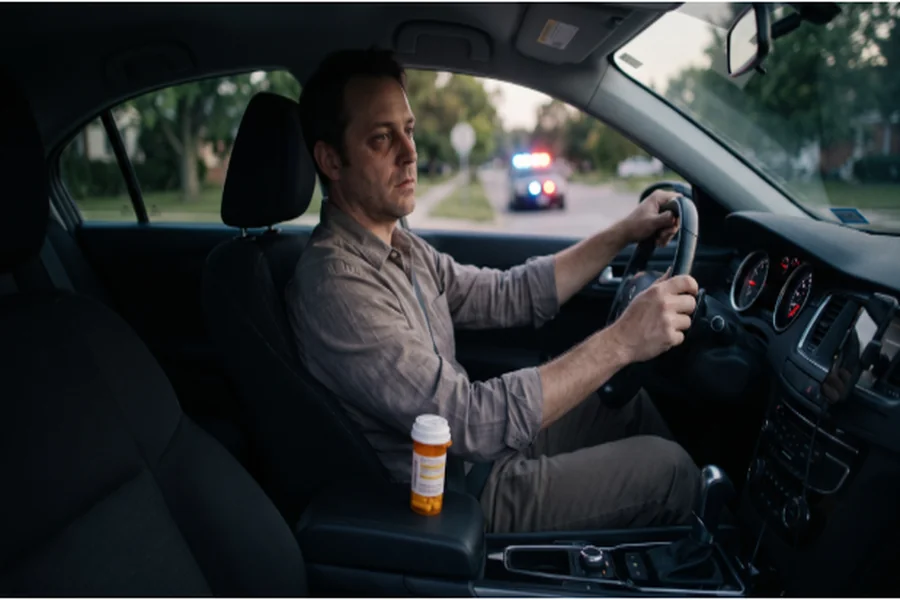
Most people carry a mental model of drunk driving built entirely around a number. Blow a 0.08, and you are guilty. Blow below it, and you are fine. That model is roughly accurate for alcohol and almost useless for everything else.
California’s impaired driving statute contains a provision that has no number attached to it at all, applies to substances obtained entirely legally, and reaches conduct that a driver may not recognize as impairment while it is happening. It is the broadest piece of the state’s DUI law, and it is the piece most drivers have never read.
The Provision Without A Threshold
California Vehicle Code section 23152 is usually discussed as if it were one offense. It is not. The full text of section 23152 lays out several distinct ways to violate it.
Subdivision (a) prohibits driving under the influence of any alcoholic beverage. Subdivision (b) is the familiar 0.08 percent per se rule. Subdivision (f) prohibits driving under the influence of any drug. Subdivision (g) covers the combined influence of alcohol and any drug.
Prescription Status Is Not A Defense
The statute defines “drug” broadly enough to include substances a physician prescribed and a pharmacist dispensed. Nothing in the language carves out lawful possession or lawful use. A valid prescription establishes that you were entitled to have the medication. It says nothing about whether you were safe to operate a vehicle after taking it.
The intuition that legal means permitted is strong, and it is wrong in this context. The FDA’s guidance on medicines that can affect driving lists categories that reach into ordinary medicine cabinets, including antihistamines, anti-anxiety medications, sleep aids, muscle relaxants, opioid pain relievers, and some antidepressants.
There Is No Number To Point To
For alcohol, a defendant can point at a breath result below the limit and argue the science. For drugs, there is no equivalent. California has not set per se concentration thresholds for prescription medications, and for most drugs the relationship between blood concentration and functional impairment is not linear or consistent across individuals.
That cuts both ways. The prosecution cannot rely on a number, so it has to prove actual impairment. The defense cannot point at a number either, so it has to attack the observations the officer made.
What The State Actually Has To Prove
Because there is no threshold, the case is built almost entirely on human observation. That is a genuinely different kind of case than a standard alcohol prosecution, and it is worth understanding what the components are.
- The driving pattern that prompted the stop, which is often unremarkable on video
- The officer’s observations of speech, coordination, and eye movement
- Performance on field sobriety exercises that were validated for alcohol, not for medication
- Any evaluation by a drug recognition expert
- A blood test showing the presence of a substance, which establishes presence and not impairment
Each is contestable. Field sobriety exercises in particular were validated against alcohol impairment, and a person with an inner ear condition, a knee injury, obesity, or fatigue can perform poorly while entirely unimpaired.
The Testing Rules Most Drivers Get Wrong
California’s implied consent framework is often described as though refusal is always the worse choice. The structure is more specific. Under the state’s chemical testing provisions, a driver lawfully arrested for DUI is deemed to have consented to a chemical test, and refusal carries its own administrative penalty on top of whatever happens in criminal court.
Where drug cases differ is that a breath test cannot detect medication. If an officer suspects drug impairment, a blood test is the mechanism, and the timeline between the stop and the draw becomes a live issue, since concentrations move during that window. The California DMV’s overview of the state’s driving under the influence process explains the parallel administrative track that runs alongside the criminal case, which most drivers do not realize exists until the deadline has passed.
That parallel track is why the early days matter so much. The administrative case has a short clock that runs independently of the court calendar, which is one reason counsel for criminal cases in Santa Ana and elsewhere in the state treat the first week after an arrest as the period where the most consequential decisions get made.
Practical Reading For Anyone On A Prescription
None of this is an argument against taking Prescribed medication. It is an argument for knowing what a specific medication does to you before you are in a position where the question matters.
A few things are worth doing regardless of whether you ever face a stop:
- Read the sedation and machinery warnings on the label rather than assuming they are boilerplate
- Ask the prescribing physician directly about driving during the first two weeks of a new medication
- Treat dose changes as new medications, because tolerance does not carry over
- Be careful with combinations, since the interaction effect is frequently larger than either drug alone
The uncomfortable part is that impairment and awareness of impairment are different things. Sedating medications degrade judgment about one’s own judgment. That is precisely the scenario the statute reaches, and why a driver’s honest belief that they were fine carries almost no weight in front of a judge.
