
 James
James
Squeeze two nasal spray bottles and the puffs look identical – a fine mist, gone in half a second. Underneath that coincidence sits a surprisingly strict piece of engineering. Every actuation of a metered pump is supposed to move the same fixed volume of liquid, every time, from the first spray in a bottle to the last. Getting that right is less about the chemistry and more about arithmetic: what is dissolved in the liquid, how much liquid leaves per spray, and therefore how much of the active compound actually lands.
What 'metered' actually means
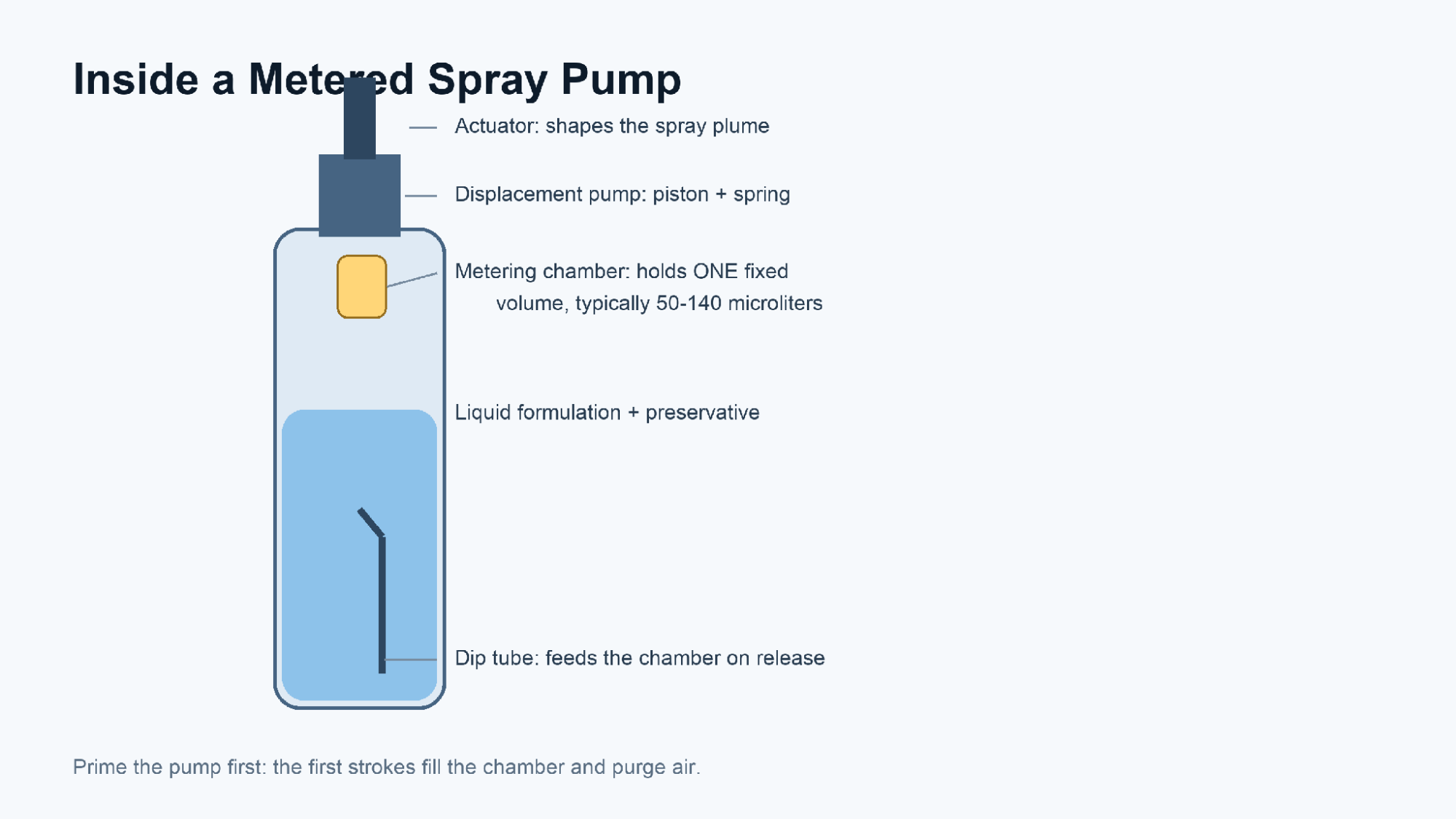
A metered nasal spray is a displacement pump. Pressing the actuator drives a piston through a small metering chamber; a spring returns it and refills the chamber through a dip tube that reaches down into the bottle. The chamber holds one fixed volume, and that volume – not the strength of your finger – defines the dose.
Industry reviews of nasal spray technology put the delivered volume of most multi-dose pumps between 50 and 140 microliters per actuation, with roughly 100 microliters per nostril considered optimal in adults. That ceiling is not arbitrary: larger volumes tend to run out of the nose rather than stay put, so formulators design the dose to fit inside what the nasal cavity can actually hold.
The three numbers that define a spray
Any spray calculation comes down to three quantities. The first is concentration – how many milligrams of compound are dissolved in each milliliter of solution. The second is spray volume – the microliters the pump's metering chamber delivers per actuation. Multiply the two and you get the third: the mass of compound delivered per spray, usually expressed in micrograms.
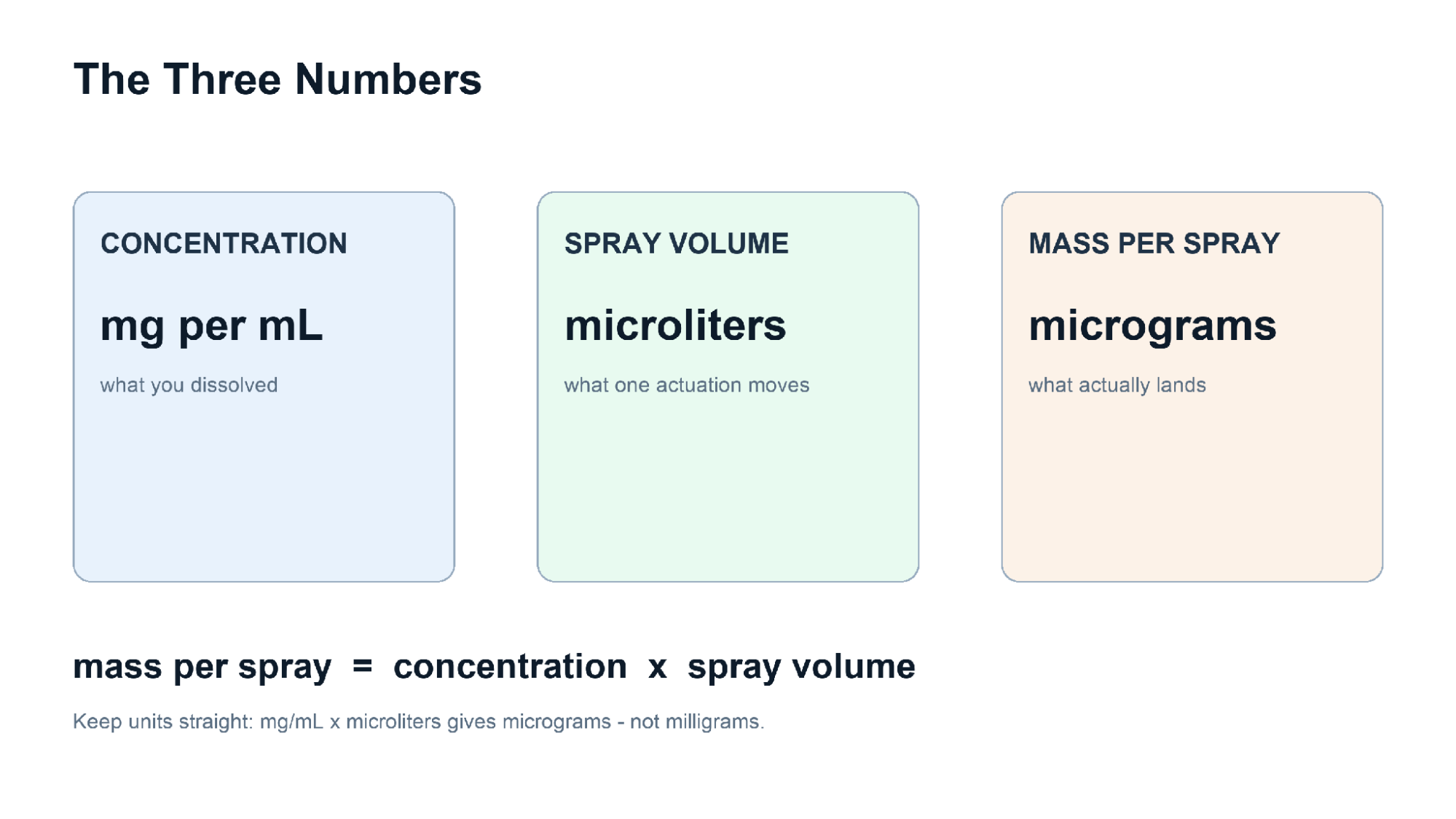
The unit trap lives in that multiplication. Milligrams per milliliter multiplied by microliters gives micrograms, not milligrams – a factor of a thousand hides in the prefix. It is the single most common error when people redo this math by hand, and it never announces itself, because the answer still looks plausible.
The same three numbers run the calculation in reverse. A research team that knows the mass it wants per spray and the pump's fixed volume can solve for the concentration it needs to mix – or, working from an already-mixed bottle, divide the usable volume by the spray volume to get total sprays, then by sprays per use to get doses per container. Bottles are routinely overfilled by a margin precisely so that the labeled count of full doses survives the priming strokes at the start.
Where small errors compound
Consider a workable example. A solution at 5 mg per milliliter, delivered by a pump that moves 100 microliters per actuation, puts 500 micrograms of dissolved compound into each spray. Now introduce a 10 percent error in either input – a solution actually mixed at 5.5 mg/mL, or a chamber that delivers 110 microliters – and every spray quietly carries 550 micrograms instead. Across a multi-dose bottle, the drift accumulates spray by spray, which is exactly why formulation work treats concentration verification and pump calibration as separate checks rather than one.
The lesson generalizes: a spray is only as accurate as its weakest input, which is why each of the three numbers gets verified on its own rather than trusted as a label claim.
The precision checks that catch drift
Regulatory guidance for nasal spray products treats dose reproducibility as the central quality attribute, and the testing reflects it. Spray content uniformity is evaluated at both the beginning and the end of a container's labeled number of actuations, so a pump that delivers accurately on spray one but fades by spray one hundred fails. Devices are expected to prevent partial metering, and actuation counters are encouraged so nobody loses track of where they are in the bottle.
Priming matters too. Air trapped in the pump and dip tube after filling means the first strokes discharge incomplete volume, so pumps are primed – fired several times into the air – until the chamber runs full. Keeping the bottle upright matters for the same reason: the dip tube has to stay submerged in liquid, or the chamber draws a partial dose.
Doing the math without a spreadsheet
None of this arithmetic is hard, but it is fiddly – unit conversions in one direction, sprays-per-container totals in the other, and a mistake that hides in a plausible-looking answer. For research teams working with compounds in solution, a purpose-built tool removes the manual step entirely;
PeptideStack's nasal spray calculator is one such example, taking concentration and pump volume as inputs and returning the mass per spray and total doses per bottle directly. Like the rest of that site, it is framed for laboratory research contexts – a way to check numbers before they end up in a protocol, not a substitute for validated analytical work.
The bottom line
A metered spray is a small machine for repeating one number: a fixed volume, at a known concentration, delivering a known mass. The pumps enforce the volume, the formulation defines the concentration, and the arithmetic ties them together. Whether the application is a commercial allergy spray or an experimental compound in a research setting, the discipline is the same – measure the three numbers, keep the units straight, and verify that what the bottle promises is what each spray delivers.
This article is for general educational purposes and describes research and formulation concepts only. Nothing here is medical advice, and research-use-only compounds are not for human or veterinary use.
