
 James
James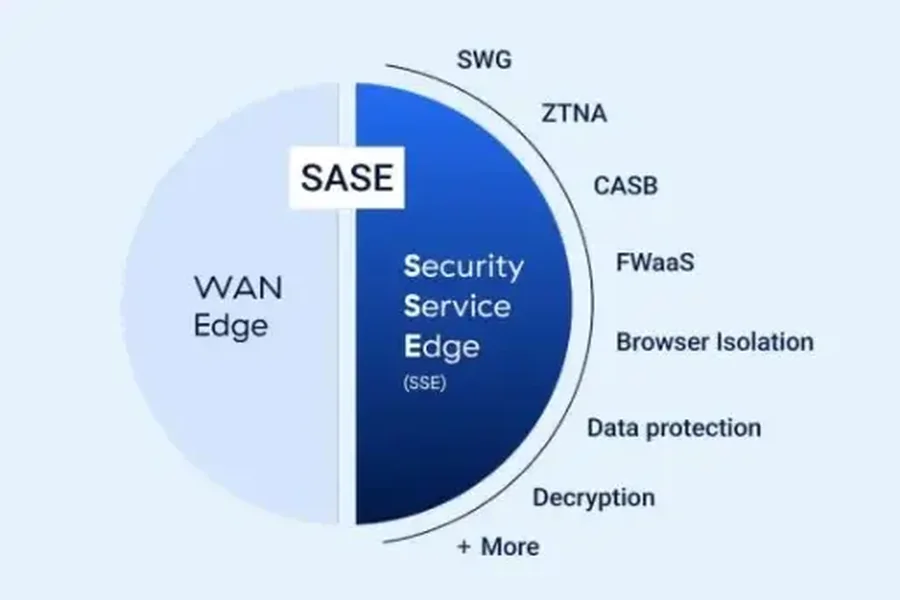
A chain of two hundred retail stores, a regional bank with dozens of branches, and a healthcare system spanning a dozen clinics all face the same security challenge that has nothing to do with their industry. Each added location just multiplies the number of places where a breach could begin, but reduces the amount of dedicated IT attention any one site will actually get.
At least it is not new… Branch environments have always been a weak spot in enterprise security. The latest firewalls, the best-staffed SOC, and the quickest IR all go to headquarters. The branch locations, on the other hand, typically run on legacy hardware with a skeletal IT presence and connect to the corporate network in ways not originally designed for today’s threat model.
SASE security across distributed enterprise branches addresses this problem by moving policy enforcement out of individual branch hardware and into a cloud-delivered service that applies the same rules everywhere. Rather than depending on a local firewall appliance that may or may not have received its latest patch, security policy lives in the cloud and gets applied consistently the moment a branch connects, regardless of what hardware sits at that specific site.
- Branch Locations Have An Unfair Share of Risk
- What Convergence Means for the Branch Security Equation
- IDENTITY VERIFICATION (FIRST DEFENSE)
- Reducing the Attack Surface of Many Sites
- Established Standards Behind the Model
- Practical Considerations for Multi-Site Organizations
- Frequently Asked Questions
- Is there still any hardware requirement at the branch locations for this approach?
- How does this help branches without a dedicated IT person?
- What if a branch loses its internet connection?
Branch Locations Have An Unfair Share of Risk
And the math of this risk is really simple. One target is a headquarters that is well defended. You have a hundred offices, each with its own little network, its own systems for point-of-sale or clinics or whatever the businesses are and if you work for one of those companies and they have not kept their employees up on security practices in the past couple of years, there are a hundred opportunities for an attacker to get a foot in the door. Once the means gained access to one point in the network, it can generally be used as a stepping stone to systems elsewhere in that organization that may be more valuable.
This dynamic played out publicly when several major UK retailers suffered coordinated attacks that began through social engineering against help desk staff rather than through any technical vulnerability. National guidance issued in response to those incidents, offering retail cyberattack security recommendations, highlighted how attackers exploited inconsistent identity verification processes across a distributed organization, a gap that hits multi-location businesses particularly hard.
What Convergence Means for the Branch Security Equation
This shift is especially important for branches with the least commitment to IT support. The same threat inspection, the same access controls, and the same visibility as headquarters continues to be enforced at a small regional office with no on-site staff, as the enforcement point has long left local infrastructure altogether.
In the past, local point solutions meant that a location’s security was only as good as whichever appliance happened to be there and whichever tech had last patched it. The dependency vanishes when enforcement is in the cloud, because all sites are attached to a continuously refined environment rather than to the hardware shipped to that site years ago.
IDENTITY VERIFICATION (FIRST DEFENSE)
Weak or inconsistent identity proofing is a major contributor to the vulnerability of distributed environments. With help desk processes being attacked more frequently, this means that getting someone into your headquarters office is much easier than verifying an employee at a remote branch in person. This is why a converged security model is so important since it applies the same identity and device posture checks regardless of request source, thus eliminating the inconsistency that attackers have learned to exploit.
In branch environments much more than in an office location that has been monitored continuously the continuous verification will make a greater difference. It is because it has fewer people really watching that traffic; a compromised credential at a branch location can otherwise sit unnoticed for far longer than the same compromise at headquarters.
Reducing the Attack Surface of Many Sites
Each branch site that manages its own local security stack is another set of firmware versions, patch schedules and configuration drift to contend with. Cloud provides a single point of control that collapses this sprawl and helps minimize the number of places an attacker can find an outdated or misconfigured device to exploit.
Centralization also helps an organization react more quickly when something goes wrong. Instead, policies or emergency blocks can be pushed to all branches at once instead of manual configurations by IT staff in dozens or hundreds of individual sites, a process that could take days when gap-prone sites stay exposed.
Established Standards Behind the Model
The identity-centric, continuous-verification approach that underpins this architecture did not emerge in isolation. Federal research offering a zero trust architecture framework overview laid out the conceptual foundation that much of this technology builds on, describing how enterprises should shift away from trusting anything based purely on network location. That framework has become a reference point for how distributed organizations think about securing environments that no longer have a single, defensible perimeter.
Practical Considerations for Multi-Site Organizations
This model rarely gets simply rolled out across dozens or hundreds of branch locations in one fell swoop. Most organizations take a phased approach, starting with their highest risk or value locations, working through configuration details in smaller numbers before rolling out across the full branch network. This step-wise approach mitigates the operational risk of rolling out end-to-end defenses, whilst providing substantial protection to those sites at greatest exposure early in the life-cycle.
Bandwidth and connectivity quality at every branch also need to be considered in planning, as a distributed security blueprint hinges on high-quality links to cloud adoption points of enforcement. Implementing such a solution would usually also require careful planning for locations with poor or unreliable internet service, where security functions should not be stuck as a bottleneck in day-to-day operations. Some organizations will choose to upgrade connectivity as part and parcel of the migration by treating the two requirements together rather than having them run in parallel.
Frequently Asked Questions
Is there still any hardware requirement at the branch locations for this approach?
Other deployments use light local hardware for connectivity, but the security policy is enforced in the cloud (not a full local security stack), which lowers the hardware footprint on each site.
How does this help branches without a dedicated IT person?
With fully centralized management, IT teams can configure and update security controls for every branch from a single console, eliminating the need for local staff to manage security hardware at each location.
What if a branch loses its internet connection?
The authorization policy may include local failover and caching capabilities that maintain fundamental connectivity and security during an outage, it merely misses the complete sophistication of certain item-delivered protections unless an active connection is restored.
