
 James
James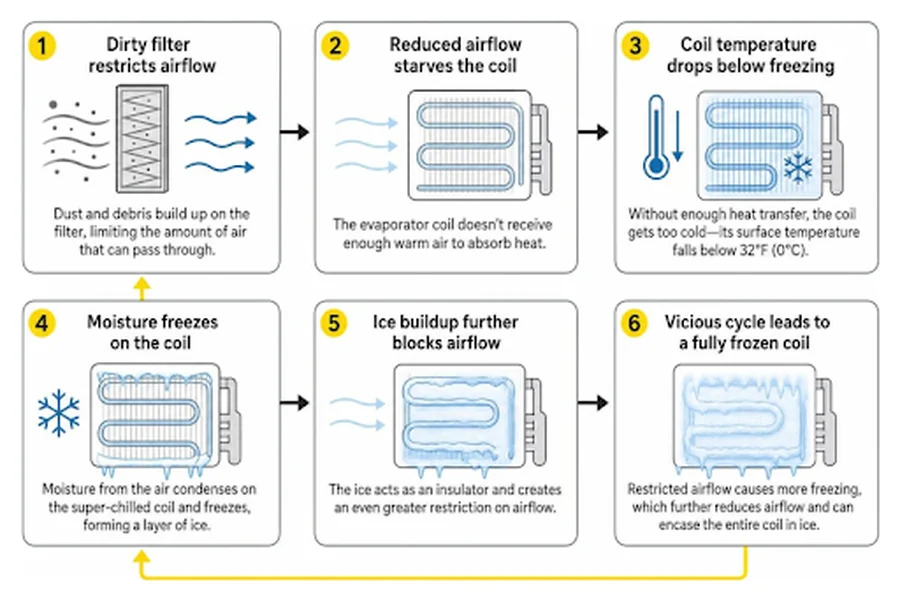
- How Dirty Filters Trigger Frozen Evaporator Coils
- The Thermodynamics of Coil Freezing
- Primary Signs Your System Is Freezing Up
- Why Honest HVAC Service Matters When Diagnosing Frozen Coils
- Distinguishing Airflow Restrictions from Refrigerant Leaks with Honest HVAC Service
- Protecting Equipment Longevity Through Honest HVAC Service
- Proper Steps for Thawing and Restoring Your HVAC System
- Safe Coil Defrosting Practices
- Establishing an Effective Filter Replacement Schedule
- Frequently Asked Questions About HVAC Coil Freezing
- Conclusion
How Dirty Filters Trigger Frozen Evaporator Coils
And when you have your air conditioner or heat pump on, it is the job of the evaporator coil, built into the inside unit, to absorb the heat of the air in your house. This is done by having a continuous supply of air over the coil. Heat is absorbed by the refrigerant in the coil which converts to a low-pressure gas. This is a heat exchange that is essential in cooling your home.
Nevertheless, a clogged air filter is a suffocating blanket to your HVAC system. Dust, pet dander, pollen, and other air particles. Filters trap dust, pet dander, pollen and other airborne particles as time passes. Such accumulation limits the amount of air that is able to enter the evaporator coil. The coil is unable to absorb the amount of heat in the air when its airflow is dramatically low. The refrigerant contained continues expanding and cooling, but the heat transfer is insufficient and the surface temperature of the coil drops to very low levels usually even lower than water freezes. When the cool, moist air of your home passes over this super-chilled surface the moisture condenses and then forms ice, a layer of ice. This ice also enhances the hindrance of the air flow forming a vicious cycle that within seconds can cover the whole coil with ice.
The Thermodynamics of Coil Freezing
The reason is that to comprehend why the absence of airflow causes freezing we must take the fundamentals of refrigeration. Refrigerant in your air conditioning works based on a pressure-temperature relationship. In the evaporator coil where the refrigerant enters, it is a low-pressure liquid. It boils (evaporates) to a gas as it takes up the heat of the indoor air and its pressure rises. It is this phase change that enables it to take in a lot of heat.
When air moves in the right direction, there is an uninterrupted supply of relatively warm indoor air to the coil, which enables the refrigerant to effectively remove heat and keep the temperature of the coil above freezing. but in case the dirty filter smothers this air passage, the coil receives no heat. The refrigerant continues to expand though it does not contain sufficient heat to absorb and plummet in temperature. This causes an abnormally low refrigerant pressure inside the coil, which in turn causes its boiling point to drop to lower than 32 o C (0 C).
When the coil gets colder than freezing, whatever moisture there is in the air that passes through the coil will condense and freeze instantly creating frost. This frost builds up forming a frost line which spreads through the coil. This frost eventually becomes a layer of ice, additional blockage to airflow which makes the problem worse. Such an accumulation of ice may even extend to the refrigerant lines and other parts, which would be a visible indication of a severe problem.
Primary Signs Your System Is Freezing Up
Identifying a frozen evaporator coil early can prevent more severe damage and costly repairs. While the most obvious sign is visible ice on the indoor unit’s coil or refrigerant lines, several other indicators can alert you to the problem.
Here are the primary signs that a dirty filter has led to frozen coils:
- Weak Airflow: You might notice that the air coming from your vents is barely a whisper, even when the fan is running at full speed. The ice buildup physically blocks the path of air.
- Warm Supply Air: Despite the system running, the air blowing into your home feels warm or only slightly cool. This is because the iced-over coil cannot effectively absorb heat from the air.
- Dripping Water: As the ice on the coil melts during system downtime, it can overwhelm the condensate drain pan, causing water to overflow and drip from the indoor unit.
- Whistling Noises: Restricted airflow can sometimes create unusual whistling or hissing sounds as air tries to squeeze through narrow passages around the ice.
- Higher Energy Bills: A system struggling against restricted airflow and an iced coil works harder to cool your home, leading to a noticeable spike in your energy consumption.
- System Running Constantly: The thermostat struggles to reach the set temperature, causing the AC to run almost non-stop without providing adequate cooling.
- Visible Ice: The most definitive sign is seeing ice directly on the evaporator coil (if accessible) or on the copper refrigerant lines connected to the indoor unit.
When you see any of the symptoms, it is important to check your air filter first since it is always the easiest and most widespread offender.
Why Honest HVAC Service Matters When Diagnosing Frozen Coils
And when presented a case where there is a frozen coil, the urge may be to place an immediate call to have it fixed. But what is important is that you get honest HVAC service. A skilled technician will make proper diagnosis a priority, and will first fix the most easy and common causes of the problem before advising an expensive fix. Such a practice will help avoid misdiagnosis and avoidance of unnecessary parts replacement and leave behind ethical recommendations that can really solve the source of the issue.
Honest Maintenance Steps Premature Component Replacement 1. Check/Replace Air Filter 1. Recommend New Coil/Compressor 2. Inspect Airflow (Ducts, Vents) 2. Overlook Simple Airflow Issues 3. Test Refrigerant Levels & Leak Detection 3. Recharge Refrigerant Without Finding Leak 4. Clean Coils (Evaporator & Condenser) 4. Suggest Expensive System Flush/Replacement 5. Verify Blower Motor Function 5. Replace Blower Motor Without Checking Capacitors/Wiring 6. Check Thermostat Settings & Calibration 6. Ignore Thermostat as a Potential Cause 7. Provide Preventive Maintenance Advice 7. Focus Solely on Immediate, Costly Fixes Outcome: Cost-Effective, Long-Term Solution Outcome: Short-Term Fix, Recurring Problems, High Costs
Distinguishing Airflow Restrictions from Refrigerant Leaks with Honest HVAC Service
While a dirty filter is the most frequent cause, frozen coils can also indicate a low refrigerant charge, often due to a leak. An honest HVAC professional understands the critical difference and employs precise diagnostic tools to pinpoint the actual issue. They won’t simply top off your refrigerant without first checking for leaks, as this only masks the problem and leads to recurring issues and environmental harm.
Technicians use specialized measurements like static pressure, superheat testing, and subcooling measurements to accurately diagnose the system. Static pressure readings help determine if there’s adequate airflow through the ductwork and coils. Superheat and subcooling values indicate how efficiently the refrigerant is absorbing and releasing heat, which can reveal if the system has the correct refrigerant charge. If low refrigerant is suspected, they will use leak detection methods, such as electronic sniffers or UV dye, to locate and repair the leak before recharging the system. This meticulous approach ensures that the problem is fixed correctly the first time, saving you money and frustration. For comprehensive support and reliable diagnostics, you can always rely on expert AC heating and air quality services.
Protecting Equipment Longevity Through Honest HVAC Service
Operating an HVAC system with a frozen coil, no matter the reason, places huge loads on the system components and may cause permanent and catastrophic damage. Especially vulnerable is the compressor which is the heart of your AC system. In the evaporator where the coil has been frozen, the refrigerant does not easily evaporate into a gas and get back to the compressor. This may result in liquid slugging, where liquid refrigerant is introduced to the compressor, which leads to mechanical stress, inside damage and, eventually, compressor damage. One of the highest cost HVAC repairs is a compressor replacement.
Moreover, limited airflow makes the blower motor work harder, which contributes to its more wear and tear and may reduce its life span. The system as a whole is inefficient devorting more energy and lowering its longevity. Honest HVAC is devoted to preventive maintenance and the timely solution of such a problem as dirty filters that help save your investment, end life of your equipment, and make sure that your system will be working over the years.
Proper Steps for Thawing and Restoring Your HVAC System
If you discover a frozen evaporator coil, the first and most crucial step is to turn off your cooling system immediately. Running it in this state can cause further, potentially irreparable, damage.
Here’s how to properly thaw and restore your HVAC system:
- Turn Off the System: Go to your thermostat and switch the system from “Cool” to “Off.” Do not just raise the temperature setting; ensure the cooling cycle is completely disengaged.
- Set Fan to “On”: While the cooling is off, change the fan setting from “Auto” to “On.” This will circulate unconditioned air over the coil, helping it thaw faster.
- Replace the Air Filter: While the coil is thawing, locate your air filter and inspect it. If it’s dirty, replace it with a clean, appropriately sized filter. This is a critical step to prevent re-freezing once the system is restarted.
- Monitor Condensate Drainage: As the ice melts, a significant amount of water will drain away. Ensure your condensate drain line is clear and that water is flowing freely to prevent overflow and potential water damage.
Safe Coil Defrosting Practices
It takes time and good safety measures to defrost a frozen coil. Do not ever use sharp objects to break away the ice, this will easily cut through the fine coils and cause a leak in refrigerant, and a minor repair will become big.
The safest method is to leave the ice to melt naturally. You will need one to three hours and the system off, with the fan on, to thaw the ice, depending on how deep the freeze was and what the temperature is in your house. To make the process faster, you may open your windows and doors in case the temperature outside is warmer than inside, or you may make a fan close to you and move it to make the air circulate. Always have towels around in case of any water leaking out of the drain pan, which may happen when it has been previously clogged. When all the ice is melted off and the condensate drains correctly you can then flip your system back to “Cool” with the new filter attached.
Establishing an Effective Filter Replacement Schedule
The simplest and most effective way to prevent frozen evaporator coils due to restricted airflow is to regularly change your air filter. The frequency is dependent upon a number of factors:
- Household Occupants: Homes with pets, children, or allergy occupants might require an increased number of changes.
- System Usage: When your AC or heat pump operates continuously, then the filters will become dirty sooner.
- Indoor Air Quality: Homes in dusty areas or near construction might need changing more frequently.
- Filter Type (MERV Rating): Filters with higher MERV (Minimum Efficiency Reporting Value) will better capture particles, although may also be more restrictive to airflow when not installed in a system that supports them.
In general, our tips would be to check your air filter monthly and change every 30 to 90 days as a rule. A cycle of 30-90 days is a norm with 1-inch pleated filters. When you have pets or allergies, set your goal towards the shorter of that range. Every September, with the cooling season coming to an end, and the heating season coming near many, it’s a great opportunity to check and change your filter during your seasonal maintenance. This proactive measure prevents not only frozen coils but also enhances the quality of indoor air, as well as the efficiency of the system.
Frequently Asked Questions About HVAC Coil Freezing
The homeowners are usually left with numerous questions when they find out they have a frozen HVAC coil. These are some of the most frequently discussed issues which may assist you to troubleshoot and know when to contact a professional.
Can running an AC with frozen coils damage the compressor?
Absolutely. One of the worst things you can cut your system off at is to run an AC when your coils are frozen and especially to the compressor. As stated above, a frozen coil does not allow the refrigerant to absorb all of the heat and turn into a gas. This implies that liquid refrigerant will be able to revisit the compressor a process termed as liquid slugging. Compressors are made to squeeze gaseous, rather than liquid. Once the liquid goes in the compressor, it may result in extreme mechanical strains resulting in bent or broken internal parts and eventually, compressor burnout. Replacement of compressor is a very costly job that may cost thousands of dollars and in some cases the homeowners may choose to change the entire outdoor unit or even the complete system instead of changing the compressor particularly when the unit being replaced is the older brand.
How long does it take for a frozen evaporator coil to completely thaw?
How long a frozen evaporator coil will thaw depends on a number of factors; the amount of ice that has accumulated, the temperature of the surrounding air in your home and whether the fan is on or not. As a rule, featuring the cooling system switch in the off position, and the fan being adjusted to the on setting, a frozen coil may require between one and three hours to warm up. In cases of severe icing, it might take longer. Before turning on the cooling operation again it is important that all the ice is melted and the condensate drain is cleared before it starts to freeze again immediately. The most important thing is patience; do not attempt to hasten the operation by chipping away the ice.
What MERV rating should be used to prevent airflow restriction?
When selecting the right MERV rating of your air filter, it is a trade-off between filtration efficiency and airflow. Although higher MERV reasons (e.g., MERV 13+) may trap more microscopic particles, it also forms resistance to airflow. Unless your HVAC system is configured to accommodate this higher amount of statical pressure a high MERV filter can limit air flow resulting in the same issues as a dirty filter; frozen coils.
Most residential HVAC systems are well served by a MERV rating of between 8-11. This range is a good filter to common allergens, dust, and pet dander without imposing so much restriction on airflow. Always refer to the manufacturers recommendation of your HVAC system or a professional to know what the best MERV rating should be in your particular system. Implementing a MERV filter that is excessive to your system will amplify the decrease in effectiveness, put additional strain to the blower motor and may freeze coils.
Conclusion
One of the easiest indicators that something is wrong with your HVAC system is the presence of a frozen evaporator coil, and in most cases it will be an irresponsibly neglected air filter. Knowledge of the immediate relationship between a limited airflow and coil freezing will allow you to make some proactive changes as a homeowner. Changing the filters every 30-90 days, not only to enhance the quality of the indoor air, but also to ensure good airflow, avoid expensive failures, and have an efficient functioning system.
With the watchful eye on the condition of your filter and an awareness of the first symptoms of frozen coil, you will be able to prevent needless repairs and prolong the life of your HVAC system. Should problems occur that cannot be addressed by merely changing the filter, it is important to consider honest and professional HVAC services to ensure proper diagnosis and remedies. Regular maintenance and proactive care will make your home comfortable, your energy bills manageable and ensure your HVAC system will be able to operate in the years to come.
